
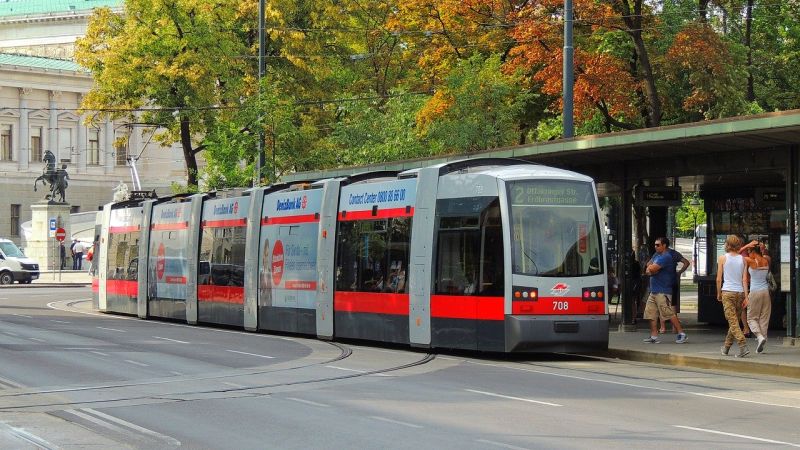
Moving around Vienna: public transport and more. Vienna is an exciting city with so many things to do and see. It will take the average visitor several days or even weeks to explore it fully. If you are visiting Vienna individually, without an organized group through a travel agency, it will be very useful to know how to move around the city and see as many attractions as you possibly can. Vienna’s transport network is often ranked among the best in the world—over 2 million people use it daily, and it covers more than 900 square kilometers. Here are our recommendations and tips.
The fastest and cheapest way of moving around Vienna: public transport
To get from point A to point B, the best and cheapest way is public transport. Vienna has comprehensive, integrated, efficient, punctual, and very affordable public transport, which includes the underground (U-Bahn), trams (Straßenbahn), suburban rail (S-Bahn), and buses. It is operated by Wiener Linien (www.wienerlinien.at), which sells tickets, manages an app, and provides all travel info. Stations are well-lit, signs are in English and German, and the ticket machines are simple to use.
U-Bahn (metro/subway)
The U-Bahn is Vienna’s metro system: fast, reliable, and covering most tourist spots via five main lines (U1, U2, U3, U4, U6). Trains run daily from about 5 AM to midnight, arriving every 2–5 minutes during peak times. Stations are marked with a blue “U” sign.
Straßenbahn (tram)
Vienna’s trams are iconic, with over 30 lines crisscrossing the city. Lines 1 and 2 circle the historic Ringstrasse, passing the Opera, Parliament, and major museums, and a dedicated tourist “Ring Tram” loops the center with audio guides in English. Trams run day and night (some lines 24/7); stops are marked “Haltestelle.” Vienna’s trams are also fairly quiet culturally—locals avoid loud conversations, and offering your seat to elderly or disabled passengers is expected.
Bus
Buses fill the gaps between metro and tram lines and are especially useful in outer districts or late at night. Night buses (“Nightlines”) carry an “N” in their route number (e.g., N38) and run roughly every 30 minutes after the U-Bahn and trams stop for the night.
Tickets, passes, and pricing
Tickets are sold by duration, and children and senior citizens ride free or at a discount. You can buy single, daily, weekly, monthly, or yearly tickets at machines in every station, via the Wiener Linien app, or at newsstands marked “Tabak Trafik.”
- Single ticket: €2.40 (adults), €1.20 (children)—valid for one journey in one direction, with line changes allowed.
- 24-hour ticket: €8.00.
- 48-hour ticket: €14.10.
- 72-hour ticket: €17.10.
- Weekly ticket: €17.10, valid Monday to Sunday—so it’s best value if your trip starts early in the week.
- Monthly ticket: €51, starting on the first of the month.
- Yearly ticket: €365—not for visitors, but if you’re moving to Vienna, this works out to €1 a day for unlimited travel.
Single tickets need to be validated (stamped) before boarding, at machines near the platform or on board; day, weekly, and monthly passes usually don’t need validation. Skipping this step on a single ticket risks a fine. Download the Wiener Linien app for tickets and schedules, but use Google Maps for navigating and trip planning—it’s proven more reliable for routing than the transit app itself.
Vienna’s transport zones
Most tourists stay within Zone 100 (the city center), and standard Vienna tickets are valid throughout it. If you travel outside this zone—to the airport or nearby towns—you’ll need an extension ticket; S-Bahn and regional trains crossing into other zones require this, so check before boarding.
Taxi, Uber, and Bolt
Classic taxi service is available throughout Vienna, alongside Uber and Bolt. Standard taxi numbers:
- +43 1 60 160 (www.taxi60160.at)
- +43 1 40 100 (www.taxi40100.at)
- +43 1 31 300 (www.taxi31300.at)
You’ll need a local number or roaming service to call these. Fares run around a €4 flag-down rate plus €1.50–€2 per km. Uber and Bolt are reliable and cashless, at similar prices to taxis, though the app pickup point at the airport can differ from the taxi stand.
Bicycles, scooters, and walking
Vienna is bike-friendly, with over 1,300 km of cycling paths. Bicycles can be rented via WienMobil Rad (formerly Citybike Wien)—the first hour is free with registration (credit card required), then around €1 per hour. Register online or at a station before your trip to save time; skipping registration is a common tourist stumbling block. Always use bike lanes, not sidewalks—helmets aren’t required but are recommended.
Electric scooters from brands like Lime, Tier, and Bird are also widely available: download the app, find a scooter, scan the QR code. Typical pricing is around a €1 unlock fee plus €0.15–€0.25 per minute. Ride in bike lanes, park responsibly, and note the minimum age is usually 18; some pedestrian zones block scooter use entirely, so check the app’s map.
Vienna’s center is compact and very walkable—many top sights are within a 10–15 minute walk of each other, and pedestrian-only streets like Graben, Kärntner Straße, and Mariahilfer Straße are full of shops, cafés, and street performers. Wear comfortable shoes for the cobblestones, and stay alert for trams and cyclists at crossings.
Accessibility
Vienna’s transport network is broadly accessible: most major U-Bahn stations have elevators, trams and buses are low-floor, and announcements are made in English and German. Guide dogs are allowed on all transport. Some older stations still lack elevators, so check station maps in advance if you need step-free access. The Vienna Mobility Service can help plan accessible routes and offers escort services.
Transport from and to Vienna Airport
There are several options for transport from and to Vienna airport, depending on your budget and situation.
Trains
The City Airport Train (CAT) is the fastest option when running as a train—16 minutes, non-stop to Wien Mitte. Note: from August 2026 until October 2027, the CAT runs as a replacement premium bus rather than a train due to modernisation works, taking around 21 minutes instead. The one-way ticket is €14.90 (return €24.90), and children up to 15 travel free. When departing Vienna, you can even check in your luggage at Wien Mitte station for some airlines.
The regular S-Bahn (S7) from ÖBB is the budget option: about €4.30–4.40, departing every 20–30 minutes, taking 23–25 minutes to Wien Mitte. A common mistake is buying only the standard €2.40 Vienna city ticket at the airport and forgetting the extra zone charge—make sure your ticket covers both the airport zone and the city zone.
Buses
Airport buses run from the terminal roughly every 20–30 minutes, with tickets around €8–€11 depending on destination (Schwedenplatz, Westbahnhof, Donaustadt). The bus takes the longest of the public options—20 to 45 minutes depending on the route—but is a reasonably economical choice if you’re not in a hurry.
Taxi to and from Vienna airport
A taxi from the airport costs between €36 and €55, depending on time of day, public holidays, and your destination. This is a good option for a group of four, who’ll pay roughly the price of individual train tickets but get delivered straight to their door.
Uber and private transfers
Uber and Bolt typically run a little cheaper than standard taxis, around €30–€45 to the city center. If you want a driver waiting with a fixed price, pre-booked private transfers are available online and are sometimes cheaper than a metered taxi, especially during busy periods.
Car rental
If you’re comfortable driving in a busy European city, you can also rent a car—all major companies (Avis, Sixt, Hertz, Europcar) have desks in the airport arrivals hall, with prices from around €30–€60 per day plus insurance, fuel, and tolls. That said, parking in central Vienna is expensive and limited, and traffic can be heavy, so this option adds more stress and cost than it saves for city-center sightseeing. Car rental makes more sense for day trips outside Vienna and into the countryside, where you can stop whenever the scenery calls for it.
Horse carriage
If you want to go around Vienna in style and enjoy the sights like something out of a fairy tale, take a horse carriage from the city center. It’s not really a way to get from A to B (carriages drop you back where you started), but it counts as a memorable mode of transport in its own right—rides run 20 minutes to an hour, cost between €40 and €80, and fit up to four people, often with the driver narrating the sights as you pass.
Hop-on, hop-off bus
Not a standard transport option, but a good way to see the central attractions quickly. Qualified guides tell the story of the city via onboard headsets, and you can hop off to explore, then hop back on later in the day. Prices start from around €20.
Common mistakes to avoid
- Forgetting to validate a single ticket before boarding.
- Buying a standard city ticket when you actually need an airport-zone extension.
- Assuming trains and trams run all night—most stop around midnight, with only Nightlines covering the gap.
- Skipping WienMobil Rad registration, then being unable to unlock a bike on the spot.
- Standing on the left of escalators—locals stand right and walk left.
Conclusion
There are many reliable and affordable options for moving around Vienna, and which is best depends on your budget, whether you’re traveling with small children, and whether you’re solo or in a group. In any case, transport will not be a problem when you visit—plan your routes, choose the right tickets, and enjoy the city.
This article was originally published on gotravelyourself.com.
Last Updated on

I’m Andrea, a travel writer based between Vienna and the Croatian coast, and I’ve been exploring both countries in depth for the past 10 years.
I’ve taken 50+ solo trips across Austria, Croatia, Germany, Switzerland, Slovenia, Italy and the wider Balkans, and I speak German, Croatian and English fluently, which means I get to have conversations most tourists never do. I know which Viennese coffee house the locals actually go to (hint: not the famous ones), and I know the Dalmatian islands well enough to tell you which ferry to take and which to avoid.
My writing is grounded in lived experience: I’ve navigated Austrian bureaucracy as a resident, hiked the Julian Alps in September when the crowds have gone, and eaten my way through Dubrovnik’s back streets at midnight. I cover Central Europe and the Adriatic for solo travellers who want something more than a highlight reel.
I also write in depth about Vienna and Austria at allaboutvienna.com, where you’ll find everything from neighbourhood guides to seasonal event coverage and expat tips.
When I’m not writing I’m usually hiking, swimming in the Adriatic, or arguing about which city makes better coffee. (It’s Vienna. It’s always Vienna.)