
 MAP
MAP SEARCH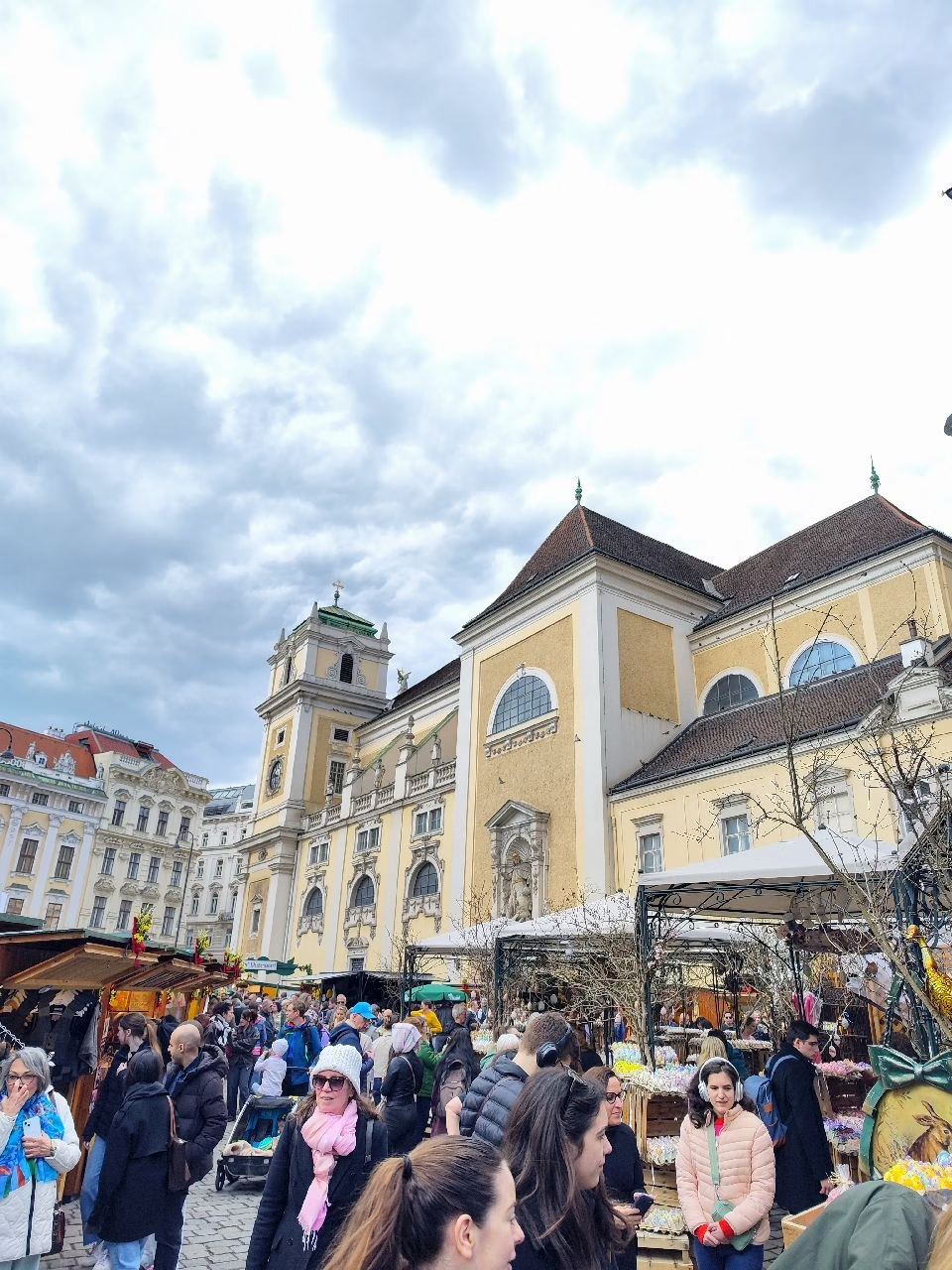
Freyung Vienna Easter Market
Address
Freyung, Vienna
GPS
48.211615, 16.3651926
The Freyung is one of the most pleasant squares in Vienna and one of the most historically layered, though it receives rather less attention than its qualities warrant. Located at the northern edge of the First District, where the Schottengasse meets the Herrengasse, it is a roughly triangular open space defined on its northern side by the Schottenstift, the monastery of the Scottish monks (actually Irish, despite the name), and surrounded on its other sides by a varied collection of palaces, noble residences, and commercial buildings that together create one of the more coherent and atmospheric urban spaces in the inner city.
The name Freyung means ‘place of freedom’ and reflects the medieval legal tradition by which the monastery’s precinct offered sanctuary: criminals and debtors who reached the monastery grounds were protected from arrest under the right of ecclesiastical asylum. This tradition made the Freyung a gathering place for those on the margins of medieval Viennese society and gave the square a character of informal refuge and social mixing that contrasts with the more formal ceremonial character of Am Hof nearby.
History of the Freyung
The Schottenstift, which gives the northern side of the Freyung its most important building, was founded in 1155 by Duke Henry II Jasomirgott of the Babenberg dynasty, who invited a group of Irish Benedictine monks from the monastery of St. James in Regensburg to establish a religious house in Vienna. The designation ‘Scottish’ (Schotten in German) that attached to the Irish monks reflects a medieval confusion between Irish and Scottish ecclesiastical identities that was common in the German-speaking world; the monks were entirely Irish in origin.
The monastery was an important cultural institution in medieval Vienna, operating a scriptorium, a school, and a hospice as well as its religious function. The Schottenkirche, the monastery’s church, was rebuilt several times over the centuries; the current Baroque church dates primarily from the 17th century. The monastery itself has been continuously occupied by Benedictine monks since its foundation in the 12th century, making it one of the oldest continuously functioning religious institutions in Vienna. The Stiftsgymnasium, attached to the Schottenstift, is one of Vienna’s most prestigious secondary schools and has educated several generations of the Austrian intellectual and political elite.
The Freyung’s secular buildings tell a parallel story of aristocratic and commercial development. The Palais Harrach, on the eastern side of the square, is a fine Baroque palace built for the Harrach family in the late 17th century and now housing a branch of the Kunsthistorisches Museum. The Palais Kinsky, also on the eastern side, is one of Johann Lukas von Hildebrandt’s masterworks, a palace of elegant proportions and refined ornamental detail that is among the finest Baroque facades in Vienna.
The Austria Fountain
At the centre of the Freyung stands the Austria Fountain (Austriabrunnen), a large sculptural group erected in 1846 to a design by Ludwig Schwanthaler. The fountain’s central figure is Austria, represented as a standing female figure who presides over four allegorical female figures representing the major rivers of the Habsburg Empire: the Danube, the Po, the Elbe, and the Vistula. The four river figures recline around the base of the central structure in poses of considerable classical elegance.
The Austria Fountain was conceived as an expression of Habsburg imperial unity at a moment, the 1840s, when that unity was beginning to be challenged by the nationalist movements that would ultimately dismember the empire in 1918. The choice of four rivers representing four different territories, each distinct in character and origin but unified under the figure of Austria at the summit, was a deliberate political statement as well as an aesthetic one.
The Schottenkirche
The Church of the Scottish Monks (Schottenkirche), on the north side of the Freyung, is the public face of the Schottenstift monastery and one of Vienna’s more significant Baroque churches, though it is less well known internationally than the Peterskirche, the Jesuitenkirche, or the Karlskirche. The current building dates primarily from a reconstruction carried out between 1638 and 1648 after the earlier Gothic church was found to be structurally unsound; the facade was added in the 18th century.
The interior of the Schottenkirche is a single-aisled Baroque space of generous proportions, with a series of side chapels containing altarpieces from the 17th and 18th centuries. The church contains the tombs of Duke Henry II Jasomirgott, the founder of the monastery, and other significant historical figures.
The Schottenstift monastery maintains a small museum, the Stiftsmuseum, which holds a collection of paintings including several important works from the Gothic and early Renaissance periods that were formerly in the monastery church. The altarpiece known as the Schottenaltar, a large series of Gothic panel paintings from the late 15th century depicting scenes from the life of the Virgin and the life of Christ, is the most significant item in the collection and one of the most important Gothic paintings in Austria.
The Freyung Passage
The Freyung is connected to the Herrengasse, the street running parallel to the south, through the Freyung Passage, a mid-19th-century arcade of considerable architectural charm. The passage was built through the courtyard of the Palais Ferstel, a historicist palace designed by Heinrich Ferstel and completed in 1860, which also contains the famous Cafe Central on its ground floor. The arcade is lined with shops and boutiques and decorated with sculptures, ornamental ironwork, and a glass roof that gives it the character of a covered shopping street rather than a mere passage between streets.
Markets on the Freyung
The Freyung hosts two of the most quality-oriented regular markets in Vienna: an organic and artisan food market that takes place on Fridays and Saturdays during the warmer months, and the seasonal Christmas market and Easter market that occupy the square in December and March/April respectively. The Friday and Saturday market, known as the Freyung Bio-Markt, focuses on Austrian regional food producers: organic meat and charcuterie, farm cheeses, bread from small bakeries, vegetables, honey, and a selection of prepared foods.
The Christmas market on the Freyung is among the most artisan-focused and least commercialised in Vienna. The setting, with the Schottenkirche as a backdrop and the Austria Fountain as the centrepiece, gives the Freyung market a quality of architectural context that the more recently established markets cannot match.
Visiting the Freyung
The Freyung is freely accessible at all times as a public square. The Schottenkirche is open for visitors during the day (free entry). The Stiftsmuseum with the Schottenaltar is open on certain days with a modest admission charge; checking the monastery website before visiting is advisable as the opening schedule is not as consistent as a commercial museum.
The Freyung is a five-minute walk from the Herrengasse U3 station, from the Schottentor U2 station via the Schottengasse, or from Am Hof (three minutes on foot).
| Location | Freyung, 1010 Vienna (1st District); north of the Herrengasse at the Schottengasse junction |
| Square | Freely accessible at all times |
| Schottenkirche | Open during daylight hours; free entry |
| Stiftsmuseum (Schottenaltar) | Open on selected days; check schottenstift.at for current schedule; admission charged |
| Freyung Passage | Daily shopping hours; free to walk through; connects to Herrengasse and Cafe Central |
| Freyung Bio-Markt | Fridays and Saturdays during warmer months; organic and artisan food producers |
| Christmas market | November to December; artisan-focused; no admission charge |
| Getting there | U3 to Herrengasse (5 min walk); U2 to Schottentor (4 min walk via Schottengasse) |
| Nearby | Am Hof (3 min walk); Judenplatz (5 min walk); Herrengasse and Hofburg (8 min walk) |