
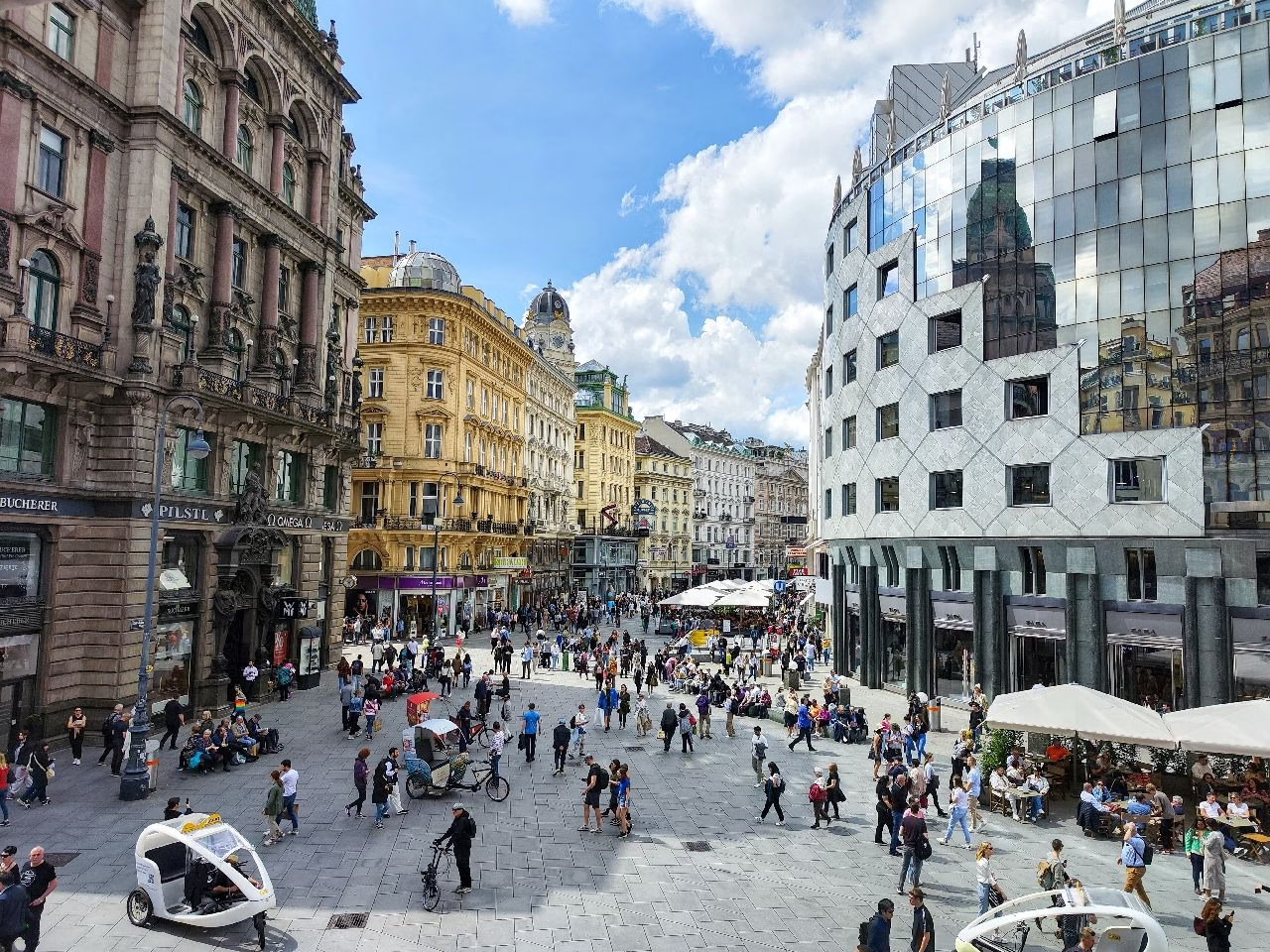
Moving to Vienna: The Complete Expat Guide
Vienna has been topping global quality of life rankings for so long that it has almost become a cliche — and yet the substance behind those rankings holds
The city offers a combination of cultural richness, functional infrastructure, excellent healthcare, outstanding public transport, low crime, significant green space, and a central European pace of life that is genuinely difficult to find elsewhere at this scale. It is not a perfect city, and the bureaucratic demands of establishing yourself here are considerable, but for those who commit to the process, Vienna tends to reward the effort generously.
This guide covers everything you need to know before and after the move: visa options by nationality, the rental market, healthcare registration, working in Vienna, the German language question, schooling, banking, and what day-to-day life in the city actually looks like once the initial admin is done. Follow the links throughout to our more detailed guides on specific topics.
Important: Austrian immigration and tax law changes regularly. The information in this guide is accurate as of 2026 but should be verified against the current Austrian government guidance at oesterreich.gv.at before making any decisions.
Why Move to Vienna
Quality of Life
Vienna has ranked first in the Economist Intelligence Unit’s Global Liveability Index for multiple consecutive years, ahead of Copenhagen, Zurich, and Melbourne. The ranking reflects the city’s combination of stability, healthcare, culture, environment, education, and infrastructure. For residents rather than tourists, this translates into practical daily reality: an efficient public transport system that makes car ownership unnecessary, a healthcare system that is comprehensive and accessible, a cultural programme of opera, theatre, and concert that would be unaffordable for most people in London or New York but is genuinely democratic in Vienna, and a physical environment of unusual beauty.
The Coffee House Culture for Residents
Moving to Vienna means the coffee house culture becomes part of your routine rather than a tourist experience. The Viennese coffee house is a workspace, a living room, a meeting room, and a reading room simultaneously. Working from a Viennese coffee house — one coffee, a glass of water, as many hours as you need — is not unusual and is the established working practice of a significant portion of the city’s creative and intellectual population.
Safety and Stability
Vienna is consistently ranked among the safest cities in the world. The crime rate is low across all categories, the political environment is stable, the public institutions function reliably, and the infrastructure is maintained to a standard that residents of many other major cities would find remarkable. For families with children, this stability is one of the primary drivers of the decision to move.
Visas & Residency
EU/EEA Citizens
Citizens of EU and EEA member states have the right to live and work in Austria without a visa. If you plan to stay longer than three months, you are required to register your residence (Meldezettel) at your local Magistratisches Bezirksamt (district administrative office) within three days of moving in. EU citizens staying more than three months should also apply for an EU citizen registration certificate (Anmeldebescheinigung). The Meldezettel — the proof of registration at your address — is the single most important document for accessing most Austrian services: opening a bank account, registering with a doctor, enrolling children in school.
Non-EU Citizens — The Red-White-Red Card
The primary route for non-EU nationals to live and work in Austria is the Red-White-Red Card (Rot-Weiss-Rot-Karte), a points-based system introduced to attract skilled workers, graduates, and other qualified individuals. There are several categories: Highly Qualified Workers (based on a points assessment of qualifications, work experience, language skills, and age), Other Key Workers (for specific shortage occupations), Graduates of Austrian Universities, and Self-Employed Key Workers.
The points threshold for the Highly Qualified Workers category is set annually by the Austrian Migration Council. Applicants must score at least 70 points from a maximum of 100 across the assessment criteria. Language skills (German and English) contribute to the score, as do Austrian qualifications and prior work experience in Austria.
The Artist / Freelancer Route
Austria has a specific visa category for self-employed individuals in the arts, culture, and related fields: the Niederlassungsbewilligung for self-employed persons. This requires demonstrating sufficient income to support yourself without recourse to Austrian social services, health insurance coverage, and a place of residence. The process is more complex than the Red-White-Red Card for employed workers but is the primary route for freelancers, remote workers, and independent professionals.
Digital Nomad Visa
Austria does not currently have a dedicated digital nomad visa in the same form as several other EU countries, but the self-employed residence permit (Niederlassungsbewilligung) can serve a similar function for remote workers with non-Austrian clients. Legal advice from an Austrian immigration lawyer is strongly recommended before beginning this process, as the requirements and interpretations have evolved significantly in recent years.
Permanent Residency and Citizenship
After five years of continuous legal residence in Austria, non-EU nationals can apply for a Daueraufenthalt-EU (permanent EU residence permit). Austrian citizenship becomes available after ten years of continuous legal residence, six years if you can demonstrate exceptional integration (including language proficiency at C1 level and active participation in Austrian civic life). Austria does not generally permit dual citizenship, which is a significant consideration for applicants from countries that require renunciation of original nationality.
More from our website: Moving to Vienna: Visa and Residency Options Explained, detailed breakdown of each route with current requirements and processing times
Finding Accommodation in Vienna
The Rental Market
Vienna’s rental market is tightly regulated and, by Western European capital city standards, relatively affordable, though prices have risen significantly since 2020. The market operates through a combination of private landlords, real estate agencies (Makler), and Vienna’s substantial social housing sector (Gemeindebau). Around 60 percent of Viennese residents live in some form of subsidised or rent-controlled housing, which has historically kept private market rents lower than in comparable cities.
The main platforms for finding private rentals are Willhaben.at, Immobilienscout24.at, and Immowelt.at. Agency commission (Maklerprovision) was capped at two months gross rent for tenant-facing fees in 2023, representing a significant improvement on the previous system. Private landlord listings (Privat, no agency) are preferable where available.
Typical Costs
As of 2026, a one-bedroom apartment in the inner districts (1st-9th) rents for approximately 1,000-1,600 euros per month unfurnished. The same apartment in the outer districts (10th-23rd, excluding Hietzing) is typically 750-1,100 euros. Two-bedroom apartments in the inner districts range from 1,400-2,200 euros. Furnished apartments (mobliert) carry a significant premium and are primarily available through short-term or relocation-focused platforms.
The Meldezettel Requirement
Before you can register with the city (Meldung), open a bank account, register with a doctor, or access most Austrian services, you need a Meldezettel signed by your landlord confirming your address. This is both a legal requirement and the foundational document for life in Vienna. Some private landlords are reluctant to provide it; understanding why and how to address this is one of the more practically useful things to know before signing a lease.
Practical note: The Meldezettel must be completed within three days of moving in and submitted to your Magistratisches Bezirksamt in person. Bring your passport, completed form, and the landlord’s signature. The process takes about ten minutes once you are there.
Social Housing (Gemeindebau)
Vienna’s Gemeindebau, municipally owned social housing, is one of the largest and most comprehensive social housing systems in the world, housing around 60 percent of the city’s population across 220,000 apartments. Access for new arrivals is limited and waiting lists are long (typically five or more years), but for EU citizens who establish residency and register early, it is worth understanding the system for medium-term planning.
Healthcare in Vienna
Austria operates a statutory social health insurance system (gesetzliche Krankenversicherung) under which all employees and their dependents are automatically enrolled through payroll contributions. The main insurance fund for employees is the Oesterreichische Gesundheitskasse (OGK). Coverage is comprehensive: GP visits, specialist referrals, hospital treatment, and most prescription medications are either fully covered or subject to a small co-payment.
Self-employed individuals and freelancers must register independently with the Sozialversicherungsanstalt der Selbststandigen (SVS) and pay contributions directly. The rates are income-dependent and can be significant in the early years of self-employment in Vienna, when income may be irregular.
To access the public health system, you need a European Health Insurance Card (for EU citizens as a bridge) or your OGK/SVS membership documentation, plus your Sozialversicherungsnummer (social security number), which is issued automatically when you register with the insurance system. GP surgeries (Arzt fur Allgemeinmedizin) operate on a referral basis for specialists; many Viennese GPs have their own patient lists and are not always accepting new registrations, it is worth asking around among neighbours and colleagues for recommendations.
Private health insurance: Zusatzversicherung (supplementary private insurance) is popular among expats and higher earners. It typically covers faster specialist access, private hospital rooms, and dental. The main providers are Uniqa, Wiener Stadtische, and Merkur.
Working in Vienna
The Job Market
Vienna’s economy is dominated by the services sector, with significant clusters in finance, professional services, technology, tourism, and the public sector. The city hosts several major international organisations (the UN, OPEC, OSCE, IAEA) that employ large international workforces. The startup and tech scene has grown significantly since 2018 and Vienna has established itself as one of Central Europe’s leading technology hubs alongside Berlin and Zurich.
Job listings are primarily found on Karriere.at (the dominant Austrian platform), StepStone.at, and Willhaben.at for local positions, and on LinkedIn and international platforms for roles at multinational companies and international organisations. English-language roles exist across technology, finance, and the international organisations, but the majority of the local job market operates in German.
The German Language Question
This is the central question for most expats considering Vienna. The honest answer is: it depends on your sector and your ambitions. In technology, finance, and international organisations, English is often the working language and fluency in German is not always required for the role itself. In daily life: dealing with bureaucracy, healthcare, services, neighbours, the absence of German creates friction that compounds over time.
Most expats in Vienna who thrive long-term are those who commit to learning German seriously, even if their professional life functions in English. The Wiener Volkshochschule (VHS) offers excellent and affordable German courses at all levels across the city. The Goethe-Institut offers more intensive instruction. Online platforms including Babbel, iTalki, and Lingoda all have good coverage of Austrian German as a variant.
Taxes and Social Contributions
Austria’s income tax rates are progressive, ranging from 0 percent on income below 12,816 euros to 55 percent on income above 1 million euros annually. The effective rate for most employees is between 25 and 42 percent. Social contributions (pension, health, unemployment) are shared between employer and employee and add approximately 18 percent on top of the income tax burden for employees.
For self-employed individuals, the tax situation is more complex and the services of a Steuerberater (tax adviser) are almost always worthwhile in the first year. Austria has tax treaties with most major countries to prevent double taxation; your home country’s treaty terms are worth verifying before you move.
Schools & Education
Vienna’s public school system is free and excellent, operating in German from the age of six. International schools offering English, French, German, and bilingual programmes exist across the city: the Vienna International School (VIS) in the 22nd District is the largest and most established, following the International Baccalaureate programme. The American International School (AIS) in Döbling, the Lycee Francais, and several German-language private schools also operate in the city.
International school places are competitive and expensive, annual fees at VIS range from approximately 18,000 to 27,000 euros depending on the year group. Some international organizations subsidize school fees for employees as part of their compensation package. For families where German is a realistic option, the public school system is a genuinely high-quality alternative and integrates children into the local community far more effectively than international schooling.
Cost of Living
| Category | Detail |
| 1BR apartment (inner districts) | 1,000-1,600 euros/month |
| 1BR apartment (outer districts) | 750-1,100 euros/month |
| Monthly transport pass | 75 euros for a 31-day ticket (or 467 euros/year for the Vienna annual pass) |
| Lunch at a local restaurant | 10-16 euros |
| Dinner at a mid-range restaurant | 25-45 euros per person |
| Coffee house Melange | 3.50-5 euros |
| Opera standing ticket | 4-15 euros |
| Monthly grocery bill (one person) | 200-350 euros |
| Private health insurance (supplement) | 40-120 euros/month depending on coverage |
| German language course (VHS) | 80-200 euros per semester |
Expat Community & Social Life
Vienna has a substantial and active international community, concentrated particularly around the UN and international organisation employees in the 22nd District but spread across the city in the technology and finance sectors. InterNations Vienna is the largest expat networking organisation and runs regular events. The Vienna Expats Facebook group is large and active and useful for practical questions. The international communities around specific national cultures, the British, American, French, and German communities in particular, each have their own social institutions.
The Viennese themselves have a reputation for initial reserve that sometimes discourages expats from making local friendships. The reputation is not entirely unfounded, Viennese social culture values depth over breadth and is slower to open than in more extrovert cities, but it is also overstated. Regular attendance at a local Kaffeehaus, a sport or hobby club, a language exchange, or a neighbourhood association (Gratsler) creates the kind of repeated contact through which Viennese friendships typically form.
Practical Admin Checklist for New Arrivals
- Register your address at the Magistratisches Bezirksamt (Meldezettel), within 3 days of moving in
- Open a bank account, Erste Bank, Raiffeisen, and Bank Austria are the most expat-friendly; N26 and Wise are useful digital alternatives for the transition period
- Register with the health insurance system (OGK for employees, SVS for self-employed)
- Find a GP (Kassenarzt), ask neighbours and colleagues for recommendations
- Buy an annual Klimaticket (365 euros) for unlimited public transport across Vienna
- Register your children’s school enrolment at the Bildungsdirektion (for public schools)
- Arrange Zusatzversicherung (supplementary health insurance) if required
- Apply for a Sozialversicherungsnummer if not automatically issued
- Engage a Steuerberater if self-employed, strongly recommended for the first year
- Begin or continue German language learning, Wiener VHS or Goethe-Institut are the most reliable options
| More Moving to Vienna guides Our Moving to Vienna section below covers each of these topics in depth — from the visa application process to finding an apartment, registering with the health system, and navigating the first months of life in the city. |

I’m Andrea, a travel writer based between Vienna and the Croatian coast, and I’ve been exploring both countries in depth for the past 10 years.
I’ve taken 50+ solo trips across Austria, Croatia, Germany, Switzerland, Slovenia, Italy and the wider Balkans, and I speak German, Croatian and English fluently, which means I get to have conversations most tourists never do. I know which Viennese coffee house the locals actually go to (hint: not the famous ones), and I know the Dalmatian islands well enough to tell you which ferry to take and which to avoid.
My writing is grounded in lived experience: I’ve navigated Austrian bureaucracy as a resident, hiked the Julian Alps in September when the crowds have gone, and eaten my way through Dubrovnik’s back streets at midnight. I cover Central Europe and the Adriatic for solo travellers who want something more than a highlight reel.
I also write in depth about Vienna and Austria at allaboutvienna.com, where you’ll find everything from neighbourhood guides to seasonal event coverage and expat tips.
When I’m not writing I’m usually hiking, swimming in the Adriatic, or arguing about which city makes better coffee. (It’s Vienna. It’s always Vienna.)
Moving to Vienna guides

Leopoldstadt Neighbourhood Guide explores Vienna’s most exciting district, detailing its cultural highlights, history, and vibrant urban life.
View more
Neubau (7th District) is Vienna’s hipster neighbourhood known for its vibrant arts scene, unique shops, and a mix of historic and modern culture.
View more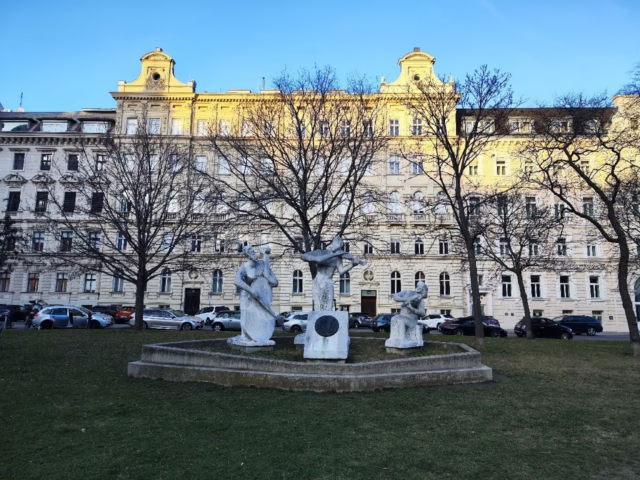
Alsergrund Guide: Vienna’s university district under the radar offers insight into its academic hubs, historic sites, and vibrant local culture.
View more
Moving to Vienna: Visa and residency options explained to help you understand the types, requirements, and processes for living legally in Austria.
View more
May 2025 in Vienna is packed with culture, music, tradition, and energy. Whether you’re into classical opera, indie film, punk rock, or elegant ballroom dancing, the city delivers something for every kind of visitor. From world-class performances at the State Opera to historic balls in Vienna’s grand halls, and from…
View more
Vienna, a city renowned for its classical music, imperial history, and rich coffee culture, is also a paradise for book lovers. From stunning Baroque libraries to cozy indie bookstores, the city offers countless literary treasures waiting to be explored. Whether you’re a casual reader, a history buff, or a serious…
View more
Many visitors to Vienna are often surprised by the vibrant vegan and vegetarian scene that the city has to offer. If you’re looking to indulge in delicious and sustainable cuisine, you’ll find a range of delightful dining options that cater to your dietary preferences. From cozy cafes to upscale eateries,…
View more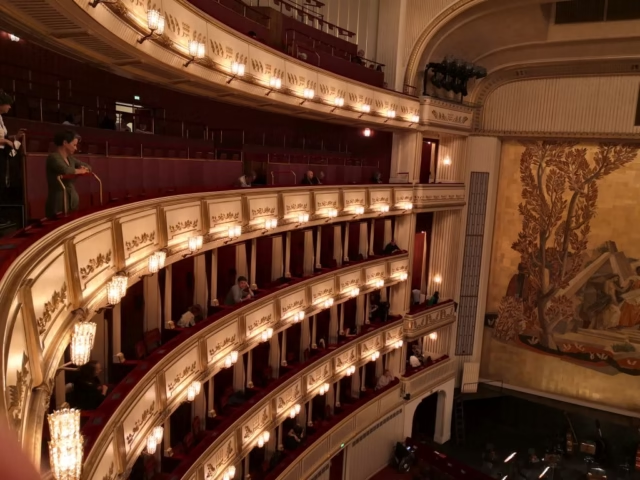
In this guide, we’ll explore Vienna’s iconic music venues, dive into its legacy of famous composers, and highlight the best classical concerts and experiences that keep Vienna at the heart of the world’s music scene.
View more
In this comprehensive guide, we’ll explore the various facets of Vienna’s cultural and entertainment scene, from iconic museums and music venues to the vibrant nightlife, beautiful parks, and nearby getaways that make this city such a joy to explore.
View more
n this guide, we will explore companies that specialize in expat relocation in Vienna, the various types of assistance available for setting up a home, how to ship your belongings to Austria, and options for temporary accommodation while you settle in.
View more
In this guide, we’ll explore everything a digital nomad needs to know about living and working in Vienna, including the best co-working spaces, finding short-term accommodation, networking opportunities with other nomads, and visa and tax considerations for freelancers.
View more
This guide provides detailed information on driving in Austria, including how to obtain an Austrian driver’s license, using car-sharing and ride-hailing services, renting or buying a car in Vienna, and understanding Austria’s parking rules and regulations.
View moreMore guides about moving to Vienna
ACTIVITIES
What to do in Vienna?
There are quite a few activities you can do in and around the city. Vienna is filled with fun activities and entertaining tours.


ATTRACTIONS
What to see in Vienna?
There are quite a few attraction you can visit in and around the city. Vienna is filled with historical and cultural landmarks.



FOOD AND DRINKS
What to eat in Vienna?
Classic Viennese food and wide variety of international cuisine are making Vienna a foodie paradise, fit for everyone’s taste.



ACCOMMODATION
Where to stay in Vienna?
Hotels for every taste, guest houses and various accomodation options available.


