

Visit Austria: The Complete Travel Guide
Austria is a small country with an outsized presence in the European imagination. A landlocked republic of nine million people in the heart of Central Europe, it punches well above its weight in almost every category that matters to a traveller: architecture, music, food, wine, alpine scenery, and the quality of daily life in its cities.
It is the country of Mozart, Freud, Klimt, and Sacher torte; of the Vienna Philharmonic, the Spanish Riding School, and the Sound of Music; of the Grossglockner high alpine road, the Hallstatt lake, and the vineyards of the Wachau.
Most visitors to Austria arrive in Vienna and stay in Vienna. This is understandable — Vienna is one of the great cities of Europe and could occupy a traveller for a week without exhaustion — but it means that the rest of the country, which is extraordinary in quite different ways, goes largely unseen. This guide covers Austria as a whole: its regions, its major cities, its landscapes, its seasonal rhythms, and the practical information you need to travel it well.
Note: This site focuses primarily on Vienna. For the capital’s dedicated travel guide, visit our Visit Vienna hub. This page covers all of Austria with particular attention to planning routes that include Vienna as a base or starting point.
Austria at a Glance
| Category | Detail |
| Capital | Vienna (Wien) |
| Population | 9.1 million |
| Area | 83,871 km² (roughly the size of Scotland or the state of Maine) |
| Official Language | German (Austrian German dialect) |
| Currency | Euro (EUR) |
| Government | Federal parliamentary republic |
| Borders | Germany, Czech Republic, Slovakia, Hungary, Slovenia, Italy, Switzerland, Liechtenstein |
| Highest Point | Grossglockner, 3,798m |
| Major Cities | Vienna, Graz, Linz, Salzburg, Innsbruck |
| UNESCO World Heritage Sites | 7 (including Vienna Historic Centre, Hallstatt-Dachstein, Wachau, Salzburg) |
Austria’s Regions
Vienna — The Imperial Capital
Vienna is both one of Austria’s nine federal states and its capital city. It sits in the northeastern corner of the country at the Danube’s bend, surrounded by Lower Austria on three sides and a short distance from the Slovak and Hungarian borders. As a travel destination, Vienna is covered in full on this site — it is the most visited part of Austria and the natural starting point for any trip to the country.
More from our website: Visit Vienna: The Complete Travel Guide, everything you need to plan a Vienna trip
Salzburg & the Salzkammergut — The Postcard Austria
Salzburg is the city that international visitors most associate with Austria after Vienna — the baroque city on the Salzach river, birthplace of Mozart, setting of The Sound of Music, and one of the most photogenic urban environments in Europe. The Hohensalzburg Fortress above the city is the largest fully preserved castle in Central Europe. The Altstadt (Old Town) is a Unesco World Heritage Site. The Mirabell Palace and Gardens are one of the finest formal baroque garden compositions in the German-speaking world.
Beyond the city, the Salzkammergut lake district stretches east — a landscape of mountain lakes, salt mines, and villages that has been drawing visitors since the 19th century. Hallstatt, the tiny lakeside village that has become arguably the most photographed village in the world, is here. St. Wolfgang, Bad Ischl (the former imperial summer residence), and Gmunden on the Traunsee are less visited and no less beautiful. The Dachstein ice caves above Hallstatt are one of the most dramatic underground experiences in Austria.
Getting there: Salzburg is 2.5 hours from Vienna by Railjet train. Hallstatt requires a train to Bad Ischl or Attnang-Puchheim, then a bus or ferry connection, so, allow 3.5 hours from Vienna. Day trip from Vienna is possible but tiring; an overnight stay is strongly recommended.
Tyrol & Vorarlberg — The Alpine West
Tyrol is Austria at its most dramatically alpine: high peaks, deep valleys, traditional villages, and a skiing infrastructure that is among the finest in the world. Innsbruck, the Tyrolean capital, is one of the most architecturally interesting small cities in Central Europe — a compact medieval and baroque old town surrounded on three sides by mountains that are visible from every street corner. The Olympic Stadium from the 1964 and 1976 Winter Olympics, the Nordkette cable car from the city centre to 2,334 metres in 20 minutes, and the extraordinary Bergisel ski jump designed by Zaha Hadid make Innsbruck a destination in its own right.
The ski resorts of Tyrol — Kitzbuhel, St. Anton am Arlberg, Ischgl, Mayrhofen, the Zillertal — are internationally famous and justify their reputations. Kitzbuhel hosts the Hahnenkamm downhill race in January, one of the most prestigious and terrifying events in alpine skiing. St. Anton is the birthplace of alpine skiing as a sport and remains one of the most demanding ski areas in the Alps.
Vorarlberg, tucked into the far west of Austria between Tyrol, Switzerland, and Liechtenstein, is the most culturally distinct region in the country — closer in dialect, architecture, and outlook to Switzerland than to Vienna. Bregenz on Lake Constance hosts the Bregenz Festival in summer, with stage performances on a floating stage on the lake that are among the most spectacular opera productions in the world.
Styria: The Green Heart of Austria
Styria (Steiermark) calls itself the ‘Green Heart of Austria’ and the description is apt, it is the most forested and, in its southern parts, the most vine-covered region in the country. The regional capital Graz is the second largest city in Austria and one of the most liveable and underrated cities in Central Europe: a Unesco World Heritage city with a beautifully preserved Renaissance old town, excellent contemporary architecture (the Kunsthaus Graz, known locally as the ‘Friendly Alien’), and a food and wine culture that competes seriously with Vienna.
Southern Styria, the Sudsteiermark wine region, produces some of Austria’s finest white wines: Sauvignon Blanc, Morillon (Chardonnay), and the Welschriesling that fills the local Buschenschank wine taverns throughout the summer. The landscape of low vine-covered hills along the Slovenian border is among the most gentle and beautiful in Austria.
Getting there: Graz is 2.5 hours from Vienna by Railjet. Southern Styria wine country is a further 45 minutes by regional train or car. The Styriarte festival in Graz (late June-July) is one of Austria’s finest classical music events.
Carinthia: Lakes, Mountains & the South
Carinthia (Karnten) in southern Austria borders Slovenia and Italy and has a distinctly Mediterranean quality in summer, warm, unhurried, and centered on its lakes, which are among the warmest and cleanest swimming lakes in Central Europe. The Worthersee is the largest and most famous, with the city of Klagenfurt on its eastern shore. The Millstattersee and Ossiachersee are quieter and preferred by Austrians who find the Worthersee too busy in July and August.
The Grossglockner High Alpine Road, Austria’s most famous mountain pass road, crosses into Carinthia from Salzburg province and is one of the great drives of Europe: 48 kilometres of hairpin bends, alpine meadows, and glacier views rising to 2,504 metres. It is open from May to November and can be driven in either direction.
Upper and Lower Austria: The Danube & the Wachau
Lower Austria (Niederosterreich) surrounds Vienna on three sides and contains some of the finest wine and landscape in the country. The Wachau valley, the stretch of the Danube between Krems and Melk, flanked by terraced vineyards, ruined medieval castles, and baroque monasteries, is a Unesco World Heritage Site and one of the most beautiful river valley landscapes in Central Europe. Stift Melk, the Benedictine abbey perched on a rocky outcrop above the Danube, is one of the finest baroque buildings in Austria.
The Wachau’s Gruner Veltliner and Riesling wines are among Austria’s best and most internationally recognised. The valley can be explored by boat (regular Danube cruises between Krems and Melk), by bicycle along the Danube Cycle Path (Donauradweg), or by car along the south bank road.
Upper Austria (Oberosterreich) is home to Linz, the country’s third city, often overlooked by visitors but genuinely interesting: the Ars Electronica Centre is one of the world’s leading centres for digital art and media; the Lentos Museum has an outstanding collection of modern and contemporary Austrian art; and the old town along the Danube has a handsome if quieter energy than Salzburg or Vienna.
Burgenland: Wine, the Pannonian Plain & the Neusiedler See
Burgenland is Austria’s newest province and its flattest, extending south along the Hungarian border across the Pannonian plain. The Neusiedler See, a vast, shallow, reed-fringed lake shared between Austria and Hungary, is one of Central Europe’s most important bird habitats and a Unesco World Heritage Site. In summer it is popular with windsurfers, cyclists, and bird-watchers; in winter it occasionally freezes over enough for ice-skating.
The wine of Burgenland, particularly the Blaufrankisch reds and the noble-rot Trockenbeerenauslese dessert wines from around Rust, is exceptional and internationally respected. The wine villages along the western shore of the Neusiedler See (Rust, Morbisch, St. Margarethen) are charming and largely undiscovered by international tourists.
Getting Around Austria
Austria’s public transport network is excellent and, with the introduction of the Klimaticket in 2021, extraordinarily good value. The Klimaticket Osterreich covers all public transport, trains, buses, urban transit, across the entire country for 1,400 euros per year (under 4 euros per day). It is the best-value transport pass in Europe for anyone planning to spend significant time in the country.
The rail network, operated primarily by OBB (Osterreichische Bundesbahnen), connects all major cities with frequent and reliable Railjet and EuroCity services. The Nightjet overnight train network connects Vienna to Graz, Salzburg, Innsbruck, Bregenz, and international destinations. Regional rail and bus services reach most smaller towns and villages, though a car is useful for exploring rural areas and mountain valleys in depth.
Tip: The OBB Sparschiene (advance purchase fares) offer significantly reduced fares on main routes, the Vienna to Salzburg Railjet regularly available from 9.90 euros with advance booking.
When to Visit Austria
Spring (April to June)
Spring is excellent for the cities and for the alpine foothills as they come into bloom. The Wachau is particularly beautiful in late April when the apricot orchards are in blossom. The cultural season in Vienna is at its richest. Snow is still present at altitude but passes are beginning to open. Crowds are moderate and prices are reasonable.
Summer (July to August)
Summer is the peak season for the lakes of Carinthia and Salzkammergut, the alpine hiking trails, the outdoor music festivals (Bregenz, Salzburg Festival, Grafenegg), and the Danube cycle paths. The Salzburg Festival in July and August is the most prestigious classical music festival in the world and should be booked many months in advance. Cities are busy and accommodation is at its most expensive.
Autumn (September to November)
Autumn offers excellent conditions across almost the entire country: the summer crowds have gone, the light is exceptional, the wine harvest is underway in the Wachau and Burgenland, and the cultural programme in Vienna and Graz restarts with the new season. Mountain conditions vary, some passes close in November, but October hiking is often outstanding. The best value season for most of Austria.
Winter (December to March)
Winter divides Austria cleanly into two experiences: the ski resorts, which are at their most expensive and most alive from December to March, and the cities, which enter the ball and Christmas market season. Vienna, Salzburg, and Graz all run excellent Christmas markets. Tyrolean and Vorarlberg ski resorts are the main draw for international winter visitors.
Austria by Interests
For Music Lovers
Austria is the single most important country in the history of Western classical music. Mozart was born in Salzburg and lived his most productive years in Vienna. Beethoven spent most of his adult life in Vienna. Schubert, Brahms, Mahler, Bruckner, and Strauss (father and son) were all Viennese or Vienna-centred. The Salzburg Festival is the apex of the international classical music calendar. The Vienna Philharmonic is the most recorded and arguably the most revered orchestra in the world.
Music tourism in Austria is well-developed: the Mozart Residence and Birthplace in Salzburg, the Beethoven Museum in Heiligenstadt (Vienna), the Haydn Museum in Eisenstadt, the Bruckner House in Linz, and the Mahler Memorial in Maiernigg (Carinthia) are all worth visits for the serious music traveller.
For Skiers
Austria has some of the finest skiing in the world, concentrated in Tyrol and Vorarlberg. St. Anton am Arlberg, the birthplace of alpine skiing, is the most technically demanding of the major resorts, with off-piste terrain that draws expert skiers from across Europe. Kitzbuhel is the most glamorous and the site of the Hahnenkamm race. Ischgl offers excellent skiing combined with a nightlife culture that is well-known in its own right. For families, the Stubaital near Innsbruck and the Zillertal offer glacier skiing and reliable snow cover from early November.
For Food & Wine Lovers
Austrian food culture is more serious and more varied than its international reputation for Schnitzel and Sachertorte suggests. Graz is regularly cited as one of the best food cities in Central Europe, with a restaurant culture that has absorbed Italian and Balkan influences alongside its Central European base. The wine regions of the Wachau, Kamptal, Kremstal, and southern Styria produce wines of international quality. The Heuriger wine tavern culture, present in Vienna, Graz, and across the wine regions, offers one of the most enjoyable and authentic food and drink experiences in the country.
For History Lovers
Austria is one of the great history destinations of Europe, with a past that shaped the continent from the Roman era through the Habsburg empire to the 20th century. Vienna’s museums are unparalleled, the Kunsthistorisches Museum, the Military History Museum, the Museum of Military History, and the vast network of palace museums tell the full story of the Habsburg era. Mauthausen concentration camp memorial, Schloss Herberstein in Styria, the medieval fortifications of Hainburg, and the Roman remains at Carnuntum and Petronell all offer powerful encounters with different chapters of Austrian and Central European history.
Practical Information for Visiting Austria
Entry Requirements
Austria is a member of the Schengen Area. EU and EEA citizens require only a valid passport or national ID card for entry. Citizens of the United States, Canada, Australia, New Zealand, Japan, South Korea, and most other developed countries can enter visa-free for up to 90 days within any 180-day period. Citizens of countries requiring a Schengen visa should apply through the Austrian embassy or consulate in their home country.
Language
German is the official language, in a variety of regional dialects that differ significantly from standard High German. Austrian German has its own vocabulary, most notably in food (Erdapfel for potato, rather than the German Kartoffel; Paradeiser for tomato; Topfen for curd cheese), and the Viennese dialect in particular is distinct enough to challenge even native German speakers from northern Germany. English is widely spoken in tourist areas, hotels, and most restaurants in the major cities, but less so in rural areas and smaller towns.
Money
Austria uses the euro. Cards are widely accepted in hotels, restaurants, and larger shops, but Austria remains more cash-oriented than Western European norms, particularly at markets, smaller restaurants, and in rural areas. It is worth carrying some cash, particularly outside the major cities.
| Start with Vienna Vienna is the natural starting point for any visit to Austria. Use our complete Vienna travel guide to plan your time in the capital, then use this page to extend your trip across the country. |
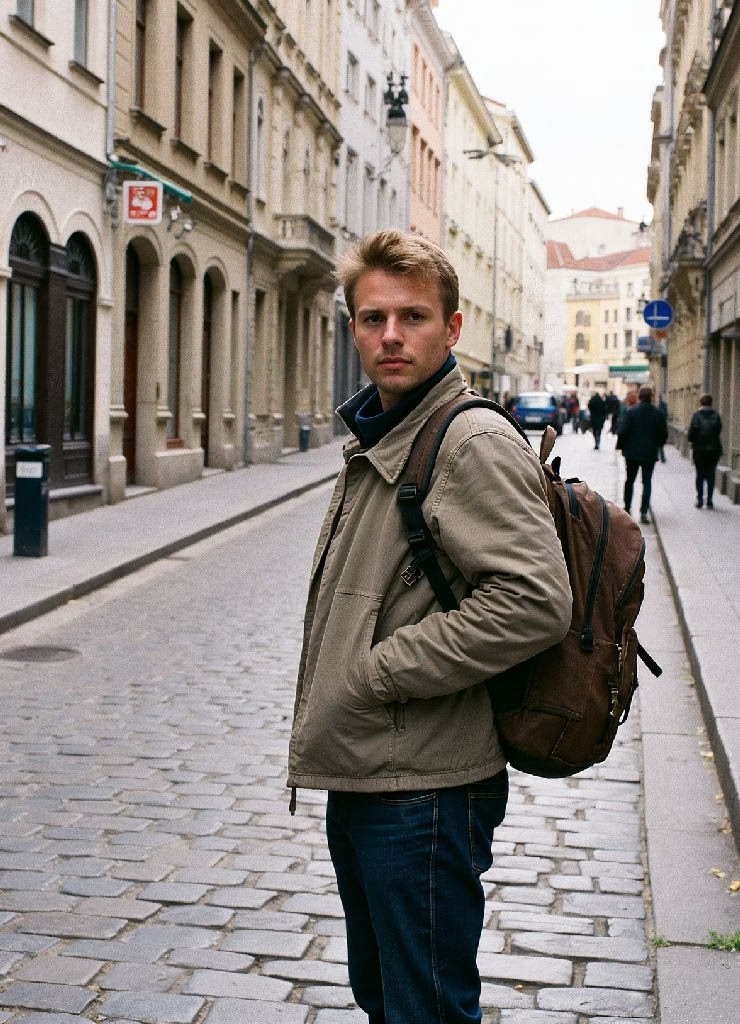
Hello, I am Jan, a travel writer based in the Czech Republic. I specialize in discovering and writing about my homeland: medieval towns, mountain hikes, the local pub scene, and off-the-tourist-radar destinations.
I also write about life as an expat in Czechia, just what it is like to live here, and not just visit. That means the little victories, the cultural surprises, and the daily realities of establishing life in this side of the world. I have also spent some time in Vienna (Austria), and I wrote several useful articles for expats there.
Visit Austria guides
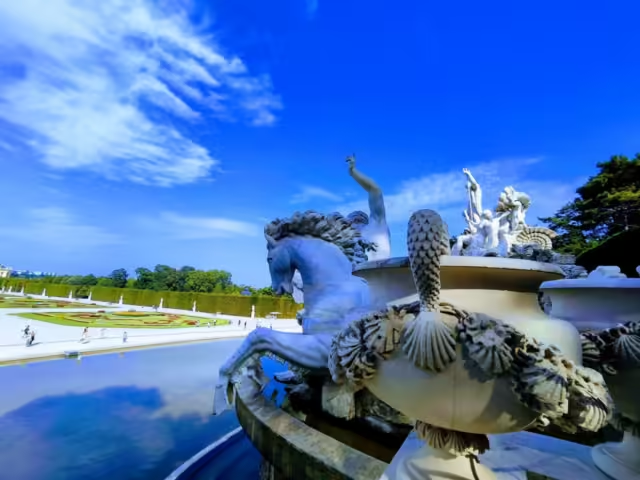
Planning to visit Schönbrunn Palace on your own? You’re about to explore one of Vienna’s most stunning landmarks at your own pace, without the rush of a group. But before you step into this magnificent palace, there are a few important things you need to know about tickets, timing, and…
View more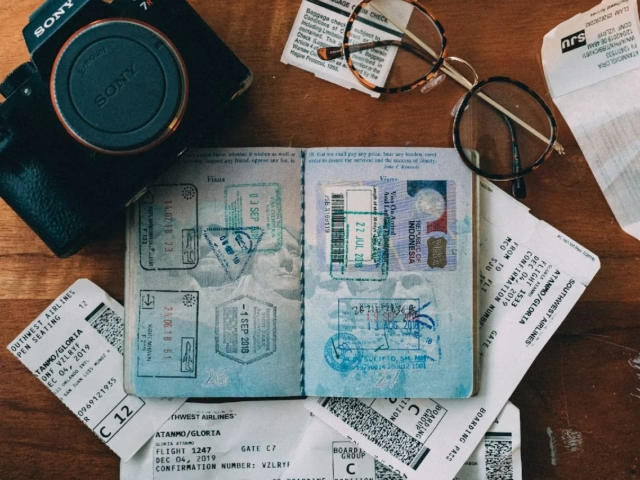
Do I Need a Visa to Visit Austria? Country-By-Country Guide explains visa requirements based on nationality to help travelers understand entry rules clearly.
View more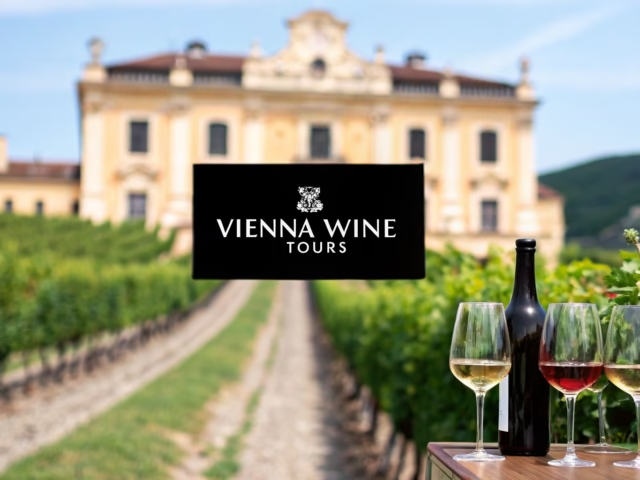
Embark on a Viennese Wine Adventure Planning Vienna wine tours can be overwhelming. This list simplifies your search, showcasing seven diverse options for exploring Vienna’s wine scene in 2025. Discover tours ranging from bike rides through urban vineyards to Danube River cruises and excursions to the renowned Wachau Valley. Whether…
View more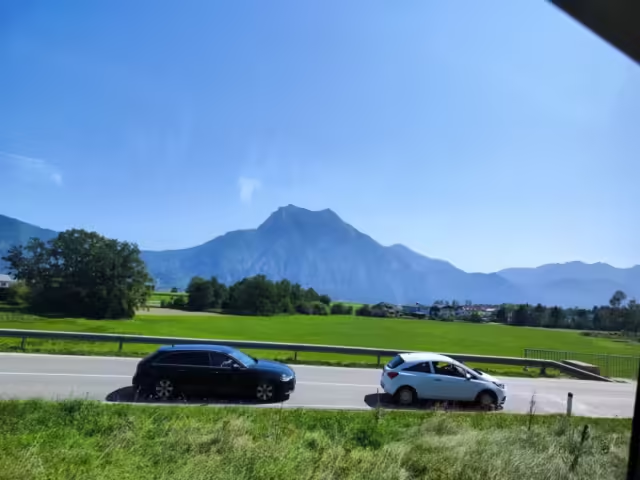
This guide provides detailed information on driving in Austria, including how to obtain an Austrian driver’s license, using car-sharing and ride-hailing services, renting or buying a car in Vienna, and understanding Austria’s parking rules and regulations.
View more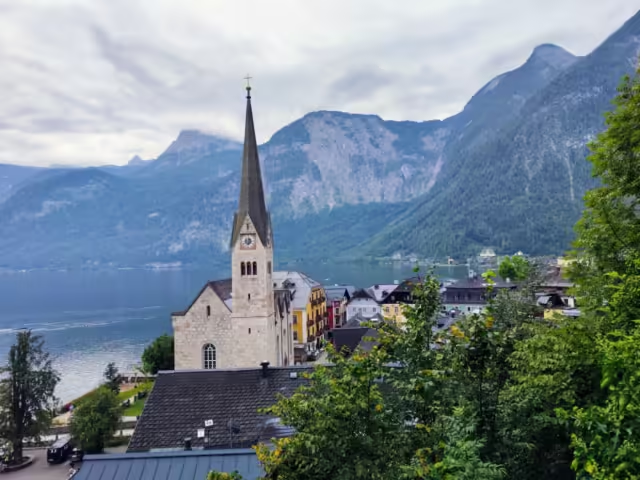
Austria is divided into nine federal states, each offering unique attractions, cultural significance, and natural beauty. The states vary greatly in terms of size, population, and economic focus, but they all share a common commitment to Austria’s federal system. Here’s a detailed overview of each state, including what they are…
View more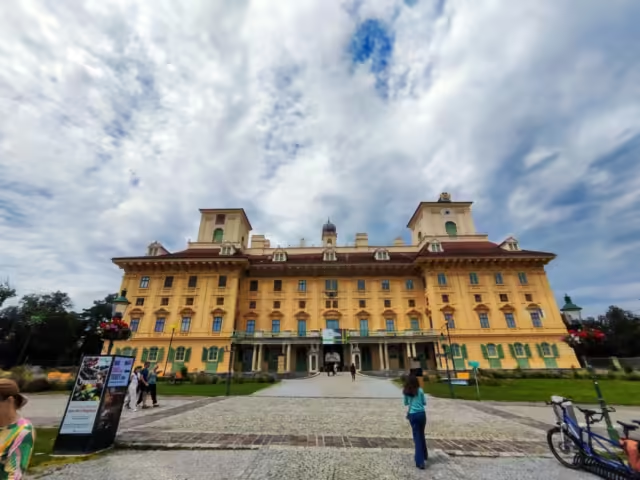
Austria is a country that enchants visitors with its stunning alpine landscapes, historic cities, and rich cultural heritage. Whether you’re planning to explore the imperial architecture of Vienna, ski in the Austrian Alps, or enjoy the serene beauty of Salzburg, knowing the best time to visit can make your trip…
View more
Are you ready to embark on an exhilarating adventure through Austria’s pristine snowy peaks? Look no further, as we invite you to join us in uncovering the heart-pounding thrills of alpine skiing! From world-class resorts nestled amidst breathtaking landscapes to adrenaline-fueled slopes that cater to skiers of all levels, Austria…
View more
Welcome to the picturesque town of Bregenz, nestled on the shores of Lake Constance in Austria. This hidden gem offers a delightful blend of stunning natural beauty, rich history, and vibrant cultural experiences. Whether you’re an art enthusiast, an adventure seeker, or simply looking for a serene escape from everyday…
View more
Welcome to Linz, Austria – a city that combines rich history with modern innovation! Nestled along the beautiful banks of the Danube River, Linz offers visitors a captivating blend of cultural treasures and vibrant attractions. Whether you’re an art enthusiast, history lover, or nature admirer, this charming city has something…
View more
Welcome to Graz, Austria – a city that is not only steeped in history but also offers an array of exciting things to see and do. Whether you’re a culture enthusiast, outdoor adventurer, or simply someone looking to immerse themselves in the charm of this picturesque destination, Graz has something…
View more
Nestled in the heart of the Austrian Alps, Innsbruck is a city that will capture your heart with its stunning natural beauty and rich cultural heritage. Whether you’re an avid skier, history buff or simply looking for a new adventure, there’s something for everyone to enjoy in this charming city….
View more
Salzburg, Austria is a veritable wonderland of attractions and activities. From the salt mine tours to the amazing scenery, there’s something for everyone. With its historical sites, museums, and natural beauty, Salzburg is an ideal destination for a family vacation or romantic getaway. If you’re planning a trip to Salzburg…
View moreMore guides about visiting Austria
ACTIVITIES
What to do in Vienna?
There are quite a few activities you can do in and around the city. Vienna is filled with fun activities and entertaining tours.


ATTRACTIONS
What to see in Vienna?
There are quite a few attraction you can visit in and around the city. Vienna is filled with historical and cultural landmarks.

FOOD AND DRINKS
What to eat in Vienna?
Classic Viennese food and wide variety of international cuisine are making Vienna a foodie paradise, fit for everyone’s taste.


ACCOMMODATION
Where to stay in Vienna?
Hotels for every taste, guest houses and various accomodation options available.


