

Digital Nomads in Vienna: The Complete Guide
The practical case for Vienna as a digital nomad base is compelling. Internet connectivity in the city is excellent. The coworking space market is developed and well-priced relative to comparable Western European cities.
Vienna does not market itself aggressively to the digital nomad community, and the city’s natural reserve means it is unlikely to do so any time soon. This works in the nomad’s favour: while other European cities have become so saturated with remote workers that the coworking spaces overflow and the cafe culture has been disrupted by laptop occupants who order one coffee and stay for eight hours, Vienna maintains a quality of daily life that accommodates remote work without being defined by it. The coffee house infrastructure, which has provided a working environment for writers, intellectuals, and independent professionals for more than two centuries, functions as effectively for a remote worker with a laptop as it did for Karl Kraus with a notebook.
The practical case for Vienna as a digital nomad base is compelling. Internet connectivity in the city is excellent. The coworking space market is developed and well-priced relative to comparable Western European cities. The public transport is so comprehensive that commuting to a coworking space from almost any neighbourhood takes under twenty minutes. The city is centrally located for travel across Europe. And the quality of life, which Vienna offers in abundance, makes the hours outside work as rewarding as the hours during it.
Why Vienna Works for Remote Work
Infrastructure and Connectivity
Austria has invested heavily in digital infrastructure over the past decade, and Vienna’s connectivity is among the best in Central Europe. Fibre broadband is widely available across all residential districts of the city; average fixed-line speeds consistently exceed 200 Mbps and frequently reach 500 Mbps or more in recently built or renovated properties. Mobile coverage across the city is comprehensive, with 5G available in the inner districts and most residential areas. International roaming within the EU is unrestricted at domestic rates for SIM cards purchased in any EU member state, making Austrian SIM cards functional across the broader European travel network that nomads typically use.
The practical experience of connectivity in Vienna is consistently good. Coworking spaces offer the speeds and reliability that professional remote work requires. The city’s coffee houses, which are increasingly offering guest wifi, vary considerably in connection quality, and the wifi situation in individual establishments is worth checking before settling in for a working session. The alternative of using mobile data tethering is entirely practical in Vienna given the quality of 4G and 5G coverage.
Quality of Life
The Vienna quality of life argument for digital nomads is the same as the argument for anyone considering living in the city, but with some specific dimensions that matter particularly to remote workers. The city is safe enough that working late in a coffee house or coworking space and walking or cycling home in the evening presents no meaningful concern. The cultural programme of opera, concerts, museums, and outdoor events means that the hours outside work are as richly stocked as the nomad wants them to be. The food culture, from the Naschmarkt to the neighbourhood Beisl to the coffee house, provides for every budget and social situation. And the city’s green spaces, including the Prater, the Donauinsel, and the surrounding Vienna Woods, provide the outdoor counterpoint to desk hours that nomads working from urban bases particularly value.
Central European Location
Vienna’s position in Central Europe is a genuine practical advantage for nomads who travel regularly. Direct flights connect Vienna International Airport (VIE) to most major European cities, with Austrian Airlines, Ryanair, Wizz Air, and other carriers providing a range of price points. The rail connections from Vienna Hauptbahnhof are excellent: Prague is four hours away, Budapest 2.5 hours, Salzburg 2.5 hours, and Munich four hours, making Vienna a natural hub for exploring Central and Eastern Europe during breaks from work. The Railjet and nightjet overnight train services extend the accessible range considerably without requiring airport logistics.
Visa and Legal Status
The visa situation for digital nomads in Vienna requires careful attention, because Austria does not currently offer a dedicated digital nomad visa of the type that Portugal, Croatia, and several other European countries have introduced. The options available to nomads depend significantly on their nationality and the length of their intended stay.
EU and EEA Citizens
Citizens of EU and EEA member states have the unrestricted right to live and work in Austria for any duration. For stays longer than three months, EU citizens must register their address at the local Magistratisches Bezirksamt within three days of moving in and apply for an Anmeldebescheinigung (registration certificate). This registration is the foundational document for accessing most Vienna services and is a straightforward administrative process rather than a restrictive immigration procedure.
Non-EU Citizens: Short Stays
Citizens of countries with visa-free access to the Schengen Area, including the United States, Canada, Australia, New Zealand, and Japan, can stay in Austria for up to 90 days within any 180-day period without a visa. This is a sufficient window for a medium-term nomad stay and is the route taken by many non-EU nomads who base themselves in Vienna for one to three months before moving on or returning home. Working remotely for a non-Austrian employer during this period is a legal grey area under current Austrian law; the formal position is that visa-free entrants are not authorised to work, but remote work for foreign employers, which has no footprint in the Austrian labour market, is treated differently in practice than in-country employment. Legal advice is recommended for those who want clarity on their specific situation.
Longer Stays: The Freelancer Route
Non-EU citizens who want to base themselves in Vienna for longer than 90 days and work remotely or as a freelancer have several potential routes, none of them straightforward. The self-employed residence permit (Niederlassungsbewilligung) covers independent professionals and freelancers but requires demonstrating sufficient income, health insurance, and a place of residence before arrival. The Red-White-Red Card for self-employed key workers is available to those whose professional profile meets the criteria. Both routes require engagement with Austrian immigration law and, practically speaking, the services of an immigration lawyer. The situation is evolving, and updates to Austrian digital nomad policy should be checked at oesterreich.gv.at before planning a long-term stay.
Legal note: This guide provides general information only and is not legal advice. Visa and work permit rules change; verify your specific situation at oesterreich.gv.at or with a qualified Austrian immigration lawyer before committing to a long-term nomad stay in Vienna
Coworking Spaces in Vienna
Vienna has a well-developed coworking market with options covering every working style and budget, from large open-plan spaces with community programming to quiet, library-like environments suited to focused individual work. The city’s coworking scene is concentrated in the inner districts and in the 7th and 8th Districts, with good options also in Leopoldstadt and the outer districts as the market has expanded.
The Major Coworking Spaces
Talent Garden Vienna, operating from the 7th District near the MuseumsQuartier, is one of the larger and better-connected coworking spaces in the city, with a focus on the technology and startup community. The space offers hot desks, dedicated desks, and private offices, with a community programme of events, workshops, and networking that makes it a natural environment for nomads who want to engage with Vienna’s startup scene. Spaces Vienna, operating in the First District, is a more design-oriented space with a focus on creative and professional services clients.
Impact Hub Vienna, in the Third District, is part of the global Impact Hub network and focuses on social enterprise and purpose-driven businesses, with a community of entrepreneurs and professionals working on projects with social and environmental dimensions. For nomads whose work falls within this broad category, Impact Hub provides both a working environment and a community of potential collaborators and contacts. WeWork operates in Vienna with its standard international formula: reliable infrastructure, flexible membership terms, and a functional if characterless working environment.
Smaller and Independent Spaces
Beyond the major operators, Vienna has a range of smaller and more characterful coworking spaces that appeal to nomads looking for a more distinctive working environment. The 7th and 8th Districts in particular have a cluster of smaller spaces that cater to designers, developers, writers, and other independent professionals. These spaces typically offer better value per desk than the major operators and a more personal community atmosphere, at the cost of somewhat less predictable amenities and programming.
Day pass options are available at most Vienna coworking spaces, making it practical to try several before committing to a longer membership. Prices range from approximately 15 to 35 euros for a day pass at most spaces, with monthly hot desk memberships typically in the 200 to 400 euro range and dedicated desk arrangements from 350 to 600 euros monthly. These prices are notably lower than equivalent spaces in London, Amsterdam, or Zurich, and the infrastructure quality is comparable.
Coworking tip: Most Vienna coworking spaces offer a free trial day before committing to any membership; take advantage of this to assess the internet speed, noise level, and community fit before paying. The Talent Garden and Impact Hub both offer structured trial periods
Working from Vienna’s Coffee Houses
The question of whether Vienna’s traditional coffee houses are suitable for remote work is one that generates strong opinions and deserves an honest answer. The traditional Viennese coffee house, in its purest form, does not provide wifi and does not expect you to work; it expects you to read, think, and drink coffee in a setting of historical and architectural distinction. Using a laptop in Cafe Central or Cafe Hawelka is, strictly speaking, not in the spirit of the institution, though neither establishment will ask you to leave.
The practical reality for nomads is that a distinction exists between the traditional coffee houses and the newer, more explicitly laptop-friendly cafes that have proliferated in the 6th, 7th, and 8th Districts since approximately 2015. The newer cafes offer fast wifi as standard, multiple power sockets at the tables, and a working atmosphere that treats laptop use as entirely normal. These establishments are the practical working environment for day-to-day remote work, while the traditional coffee houses serve as the setting for a working lunch, a client meeting over Melange, or a contemplative break in the middle of the working day.
Best Neighbourhoods for Laptop-Friendly Cafes
The 7th District (Neubau) has the highest concentration of laptop-friendly cafes in Vienna, a consequence of the neighbourhood’s creative and freelance-heavy population. The streets around the MuseumsQuartier and the Burggasse are particularly well supplied. The 8th District (Josefstadt) has a quieter selection of good working cafes catering to the academic and professional community around the University of Vienna. The 6th District (Mariahilf) and the 4th District (Wieden), particularly the Naschmarkt area, have good options that combine working cafe infrastructure with access to excellent food and coffee.
The First District (Innere Stadt) is less well suited to sustained laptop working: the cafes are either traditional establishments where laptop use feels inappropriate or tourist-oriented establishments where the wifi is unreliable and the atmosphere is not conducive to concentration. Using the First District for cultural exploration and reverting to the adjacent districts for working sessions is the most practical approach.
Accommodation for Longer Nomad Stays
Nomads staying in Vienna for more than a week or two will generally find apartments more practical and cost-effective than hotels. The city’s apartment rental market, accessible through Airbnb, Booking.com, and local platforms including Willhaben and Immoscout, has a substantial supply of short-term and medium-term rentals across all the relevant districts.
Monthly rental prices for a one-bedroom apartment in the inner districts range from approximately 1,200 to 2,000 euros depending on location, quality, and furnishing. The outer districts offer noticeably lower prices: 800 to 1,300 euros per month for a comparable apartment in the 10th through 15th Districts. For nomads willing to commute by public transport from a quieter residential base, the outer districts offer significantly better value without sacrificing the quality of Vienna’s cultural and social life, which is accessible from anywhere in the city within 20 to 30 minutes by tram or U-Bahn.
Community and Networking
Vienna’s international and nomad community is smaller and less self-organised than in cities like Lisbon, Berlin, or Barcelona, which have established themselves as major nomad destinations with dedicated community infrastructure. This is changing: the Meetup.com scene in Vienna has grown significantly since 2020, and there are active communities of English-speaking professionals, startup founders, and remote workers who organise regular events.
The most useful networks for arriving nomads include: Meetup.com Vienna groups covering technology, entrepreneurship, and language exchange; the Internations Vienna chapter, which organises regular events for international professionals and expatriates; the Vienna startup community centred around the Austrian Startup Association and the various startup events held at the Tech Gate and WU campus; and the Couchsurfing Vienna group, which despite the organisation’s declining global profile maintains an active local community with regular meetups.
The coworking spaces themselves, particularly Talent Garden and Impact Hub, are among the best sources of community for nomads in Vienna. Both spaces run regular events that are open to members and sometimes to the public, covering topics relevant to the professional interests of their membership. Attending a few of these events in the first weeks of a Vienna stay is one of the most reliable ways to begin building a local professional and social network.
Day-to-Day Nomad Life in Vienna
SIM Cards and Connectivity
Austrian SIM cards are available from the major carriers (A1, Magenta, and Drei) at their retail shops and from supermarkets and convenience stores. Prepaid SIM cards with data packages suited to nomad use are available from all three carriers; the Drei network in particular has a reputation for good coverage and competitive data pricing. EU roaming rules mean that an Austrian SIM can be used across the EU at domestic rates, making it a practical choice for nomads travelling frequently within Europe. eSIM options are available from all three carriers for devices that support them.
Banking
Traditional Austrian bank accounts require proof of residence (Meldezettel) and are therefore accessible only to nomads who have registered an address. For stays without formal registration, digital banking is the practical solution: N26 (a German digital bank available across the EU with Austrian roots) and Wise both operate without requiring physical address registration and provide the international payment capabilities that nomad banking requires. Revolut is also widely used by the international community in Vienna. Austrian ATMs accept all major international cards without surcharges, and card payments are now accepted in the vast majority of Vienna establishments, though some traditional coffee houses, markets, and smaller restaurants continue to prefer cash.
Getting Around
The annual Klimaticket, at 1,400 euros for twelve months of unlimited public transport across all of Austria, is the most cost-effective transport solution for nomads planning to stay in Vienna for three months or more and to travel within Austria regularly. For shorter stays, the monthly Vienna public transport ticket (Monatskarte) at 51 euros covers unlimited travel within the Vienna fare zone. Both options eliminate the need for individual journey tickets entirely and make the decision of whether to take the tram or the U-Bahn or to walk a purely practical one rather than a financial calculation.
Internal link: See our Moving to Vienna guide for the full breakdown of visa options, registration requirements, healthcare access, and the practical steps of establishing yourself in the city for a longer stay
| Topic | Detail |
| Best neighbourhoods to base | 7th (Neubau), 8th (Josefstadt), 6th (Mariahilf), 2nd (Leopoldstadt) |
| Coworking day pass | 15 to 35 euros; monthly hot desk 200 to 400 euros |
| 1BR apartment (inner districts) | 1,200 to 2,000 euros per month (furnished, short-term) |
| Public transport (monthly) | 51 euros (Vienna zone); 1,400 euros per year (all Austria, Klimaticket) |
| Best wifi cafes | 7th District (Neubau) has the highest concentration |
| SIM card providers | A1, Magenta, Drei; Drei recommended for value; eSIM available |
| Digital banking | N26, Wise, Revolut all practical without Austrian address |
| Internet speed | Fibre broadly available; typical residential speeds 200 to 500+ Mbps |
| Visa: under 90 days | Visa-free for most developed-country passport holders (Schengen rules apply) |
| Visa: over 90 days | No dedicated digital nomad visa; Niederlassungsbewilligung for self-employed; legal advice recommended |
| Nomad community | Meetup.com Vienna; Internations Vienna; coworking space communities |
| Best season for nomads | September to November and March to May; shoulder seasons for lower prices and fewer tourists |
| Ready to work from Vienna? Use our neighbourhood guides to choose your base, our Moving to Vienna hub for the practical registration and banking steps, and our coworking and cafe recommendations to set up a working routine from day one. |
Hello, I am Jan, a travel writer based in the Czech Republic. I specialize in discovering and writing about my homeland: medieval towns, mountain hikes, the local pub scene, and off-the-tourist-radar destinations.
I also write about life as an expat in Czechia, just what it is like to live here, and not just visit. That means the little victories, the cultural surprises, and the daily realities of establishing life in this side of the world. I have also spent some time in Vienna (Austria), and I wrote several useful articles for expats there.
Digital nomads in Vienna guides

Starting fresh in a new city can feel exciting, but it also comes with its challenges—especially when it comes to making friends. If you’re a digital nomad in Vienna, you might find yourself wondering how to connect with others beyond your laptop screen. You want genuine connections, people who share…
View more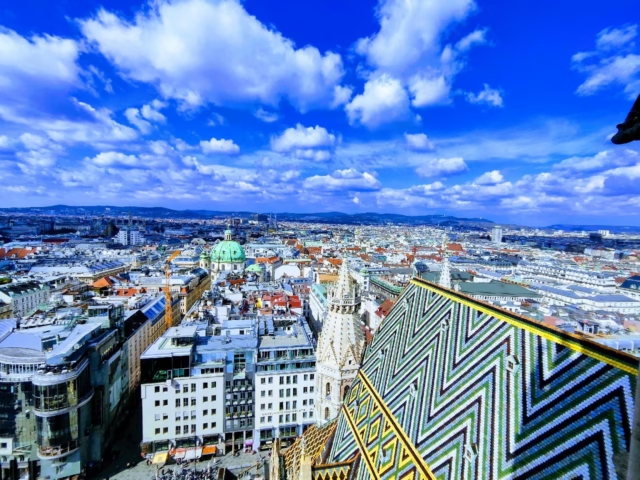
If you’re a digital nomad looking to settle in a city that blends rich history with modern convenience, Vienna should be at the top of your list. But with so many neighborhoods to choose from, how do you find the perfect spot that fits your lifestyle? Whether you crave vibrant…
View more
Are you ready to discover a city where rich history meets modern digital freedom? Vienna is not just about stunning architecture and classical music—it’s rapidly becoming a hotspot for digital nomads like you. Imagine working from cozy cafés, joining vibrant communities of like-minded remote workers, and enjoying a lifestyle that…
View more
If you’re planning to work remotely from Vienna, understanding the city’s unique rules and etiquette can make all the difference.
View more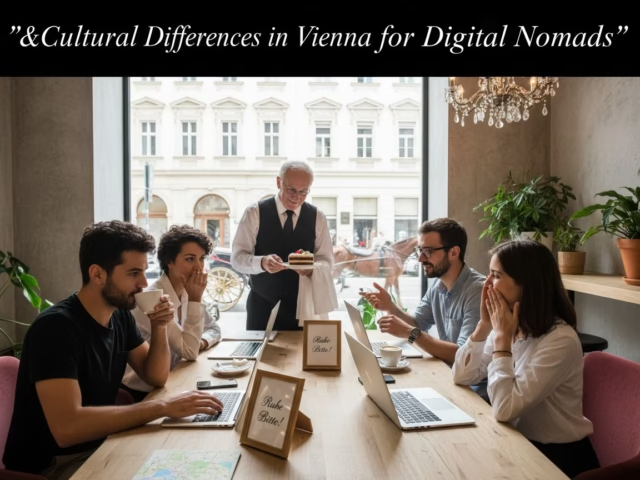
You’re about to dive into a city that’s rich in history, culture, and surprises—Vienna. But if you’re a digital nomad, moving here isn’t just about finding the best café with Wi-Fi.It’s about understanding how daily life, work habits, and social norms differ from what you’re used to. Imagine avoiding awkward…
View more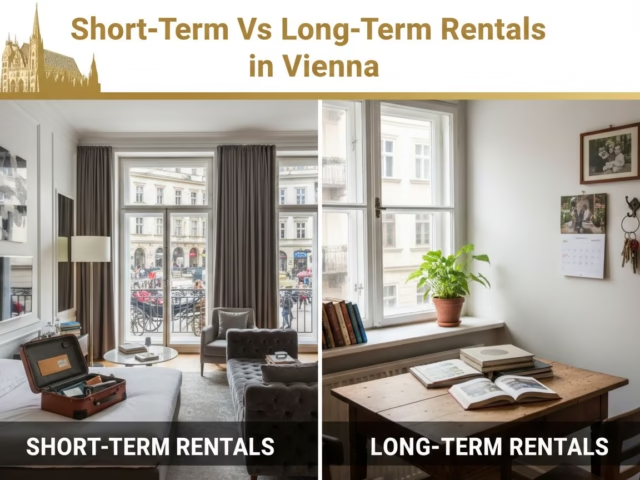
Are you planning a move to Vienna or just curious about the best rental options in this vibrant city? Choosing between short-term and long-term rentals can feel overwhelming.Each option has its own perks and pitfalls, affecting your budget, lifestyle, and comfort in different ways. Whether you’re a student, a professional,…
View moreLooking for a perfect spot in Vienna where you can live comfortably without breaking the bank? If you’re a digital nomad, finding an affordable neighborhood that also offers a great vibe and reliable amenities is key to making your remote work experience enjoyable.Vienna has many neighborhoods that balance cost, culture,…
View moreLooking for the perfect place to live and work while exploring Vienna? If you’re a digital nomad, finding a coliving space that matches your lifestyle can change everything.Imagine having a comfortable home, a productive workspace, and a vibrant community all under one roof. Vienna offers just that—a range of coliving…
View moreLooking for the perfect spot to work while enjoying everything Vienna has to offer? If you’re a digital nomad, finding a coworking space that fits your needs can make all the difference in your productivity and overall experience.You want fast internet, a comfortable environment, and a community that inspires creativity…
View more
Are you dreaming of working from a cozy café in Vienna while exploring its rich history and vibrant culture? If so, understanding your visa options is key to making your remote work experience smooth and legal.Vienna may not have a specific digital nomad visa yet, but there are smart ways…
View moreIf you’re a digital nomad making Vienna your base, managing your money smoothly is key to enjoying your stay without stress. Finding the right banking options tailored to your unique lifestyle can save you time, fees, and headaches.Whether you need easy access to international transfers, multi-currency accounts, or seamless online…
View moreAre you a freelancer dreaming of living and working in the vibrant city of Vienna? Navigating the immigration process can feel overwhelming, but the Vienna Red-White-Red Card for Freelancers might be your key to making this dream a reality.This special residence permit is designed to help skilled self-employed professionals like…
View moreMore guides about digital nomads in to Vienna
ACTIVITIES
What to do in Vienna?
There are quite a few activities you can do in and around the city. Vienna is filled with fun activities and entertaining tours.


ATTRACTIONS
What to see in Vienna?
There are quite a few attraction you can visit in and around the city. Vienna is filled with historical and cultural landmarks.

FOOD AND DRINKS
What to eat in Vienna?
Classic Viennese food and wide variety of international cuisine are making Vienna a foodie paradise, fit for everyone’s taste.



ACCOMMODATION
Where to stay in Vienna?
Hotels for every taste, guest houses and various accomodation options available.


