

Vienna has shaped world culture more than almost any city its size. Composers, scientists, artists, and thinkers who either grew up here or built their careers here have left a mark that still defines the city today, from the concert halls named after them to the museums built around their work. Here is a guide to some of the most significant figures connected to Vienna, along with what they actually achieved and why it still matters.
Composers
Wolfgang Amadeus Mozart (1756-1791)
Mozart was born in Salzburg, not Vienna, but it was in Vienna that his career reached its height. He moved to the city in 1781 and spent the last decade of his life there, composing some of his most famous works, including “The Marriage of Figaro,” “Don Giovanni,” and “The Magic Flute.” A child prodigy who was composing music and performing for European royalty by the age of five, Mozart wrote more than 600 works in his short life. He died in Vienna in 1791 at just 35, and the exact cause of his death remains debated by historians to this day.
Ludwig van Beethoven (1770-1827)
Born in Bonn, Germany, Beethoven moved to Vienna in his early twenties to study under Joseph Haydn and never left. He is best known for his nine symphonies, particularly the Fifth and the Ninth (whose final movement, “Ode to Joy,” was one of the first major works to include a full choir). Beethoven began losing his hearing in his late twenties and was almost completely deaf by the time he composed his later masterpieces, a fact that makes his achievement all the more remarkable.
Franz Schubert (1797-1828)
Unlike Mozart and Beethoven, Schubert was actually born in Vienna. He is considered one of the most important composers of the early Romantic period, known especially for his lieder (German art songs), of which he wrote over 600, alongside symphonies and chamber music. Schubert’s talent went largely unrecognized during his lifetime; he died at just 31, and much of his work was published only after his death. He was a close friend of Beethoven and was among the torchbearers at Beethoven’s funeral.
Johann Strauss II (1825-1899)
Known as the “Waltz King,” Johann Strauss II was born in Vienna, the son of composer Johann Strauss I. He composed over 500 works, including operettas, polkas, and marches, but is best remembered for “The Blue Danube,” which remains a fixture of the Vienna Philharmonic’s annual New Year’s Concert. Strauss II popularized the Viennese waltz as a serious concert form, not just a dance.
Johann Hölzel, “Falco” (1957-1998)
Born in Vienna, Falco became Austria’s most internationally successful pop star. His 1985 song “Rock Me Amadeus,” inspired by Mozart, reached number one on the US Billboard Hot 100, making him the only artist to date to top the American charts with a German-language song. He died in a car accident in the Dominican Republic in 1998, just before his 41st birthday.
Scientists and Thinkers
Sigmund Freud (1856-1939)
Freud was born in Freiberg, Moravia (in what is now the Czech Republic), but moved to Vienna as a child and lived and worked there for most of his life. He is known as the father of psychoanalysis, having developed the theory of the unconscious mind and introduced concepts like the id, ego, and superego. His former home and office on Berggasse is now the Sigmund Freud Museum. Freud fled Vienna for London in 1938 after the Nazi annexation of Austria.
Erwin Schrödinger (1887-1961)
Born in Vienna, Schrödinger became one of the founding figures of quantum mechanics. His Schrödinger equation, which describes how the quantum state of a physical system changes over time, won him the Nobel Prize in Physics in 1933. He is also known for the “Schrödinger’s cat” thought experiment, still used today to illustrate the strangeness of quantum superposition. He fled Austria after the Nazi annexation and later helped establish the Dublin Institute for Advanced Studies.
Friedrich Hayek (1899-1992)
Born in Vienna, Hayek became one of the most influential economists and political philosophers of the 20th century. He won the Nobel Prize in Economic Sciences in 1974 for his work on money and economic fluctuations, and his arguments for free markets and against centralized economic planning shaped decades of subsequent economic policy debate.
Ludwig Wittgenstein (1889-1951)
Born in Vienna into one of the city’s wealthiest families, Wittgenstein became one of the most influential philosophers of the 20th century, reshaping how philosophers think about language, logic, and meaning. His two major works, the “Tractatus Logico-Philosophicus” and the posthumously published “Philosophical Investigations,” represent two distinct and highly influential phases of his thinking.
Artists
Gustav Klimt (1862-1918)
Born in a Vienna suburb, Klimt became the leading figure of the Vienna Secession movement, which broke away from the conservative art establishment of the time. His distinctive style, marked by gold leaf and intricate patterning, is best known through “The Kiss” and “Portrait of Adele Bloch-Bauer I,” the latter of which sold for $135 million in 2006 following a high-profile restitution case.
Egon Schiele (1890-1918)
A student and protégé of Klimt, Schiele became one of the leading figures of Austrian Expressionism, known for raw, provocative figure studies that broke sharply with the decorative style of his mentor. He died of Spanish flu in 1918, just three days after his pregnant wife died of the same illness, at only 28 years old.
Friedensreich Hundertwasser (1928-2000)
Born in Vienna, Hundertwasser was a painter and architect known for colorful, irregular designs that rejected straight lines in favor of organic, uneven forms. His best-known work, the Hundertwasserhaus apartment building, remains one of Vienna’s most visited pieces of architecture.
Writers
Arthur Schnitzler (1862-1931)
Born in Vienna, Schnitzler was a playwright and novelist whose work, including “La Ronde” and “Dream Story” (the basis for Stanley Kubrick’s “Eyes Wide Shut”), explored the psychology and social hypocrisies of turn-of-the-century Viennese society.
Stefan Zweig (1881-1942)
Born in Vienna, Zweig became one of the most widely translated authors of his era, known for novellas and biographies exploring human psychology under pressure. He fled Austria after the Nazi annexation and, having lost hope for the future of Europe, died by suicide in Brazil in 1942 alongside his wife.
Modern Figures
Christoph Waltz (b. 1956)
Born in Vienna into a family of theater professionals, Waltz became one of the most acclaimed actors in contemporary cinema, winning two Academy Awards for Best Supporting Actor for his roles in Quentin Tarantino’s “Inglourious Basterds” (2009) and “Django Unchained” (2012).
Niki Lauda (1949-2019)
Born and raised in Vienna, Lauda became a three-time Formula One World Champion. His comeback from a horrific, near-fatal crash at the 1976 German Grand Prix, returning to race just weeks later despite severe burns, remains one of the most famous stories in motorsport history. He later founded several airlines and served as non-executive chairman of the Mercedes F1 team.
Conchita Wurst / Tom Neuwirth (b. 1988)
Neuwirth was born in Gmunden, Upper Austria, but has been based in Vienna for most of his adult career. Performing as Conchita Wurst, he won the Eurovision Song Contest 2014 for Austria with “Rise Like a Phoenix,” bringing him international attention.
Historical Figures
Marie Antoinette (1755-1793)
Born in Vienna’s Hofburg Palace as an Archduchess of Austria, she was married off to the future King Louis XVI of France at age 14. Her life and execution during the French Revolution have made her an enduring, if tragic, figure in European history.
Emperor Franz Joseph I (1830-1916)
Franz Joseph ruled Austria from 1848 until his death in 1916, one of the longest reigns of any European monarch. His era saw the construction of much of Vienna’s Ringstrasse, including the Vienna State Opera and Parliament building, and the transformation of Vienna into the grand imperial capital that visitors still recognize today.
These figures represent only a portion of the people who have shaped Vienna, and been shaped by it in turn. Walking the city today, from the Freud Museum to the Hundertwasserhaus to the Musikverein where Strauss waltzes still open the New Year, is in many ways a walk through their combined legacy.
Last Updated on
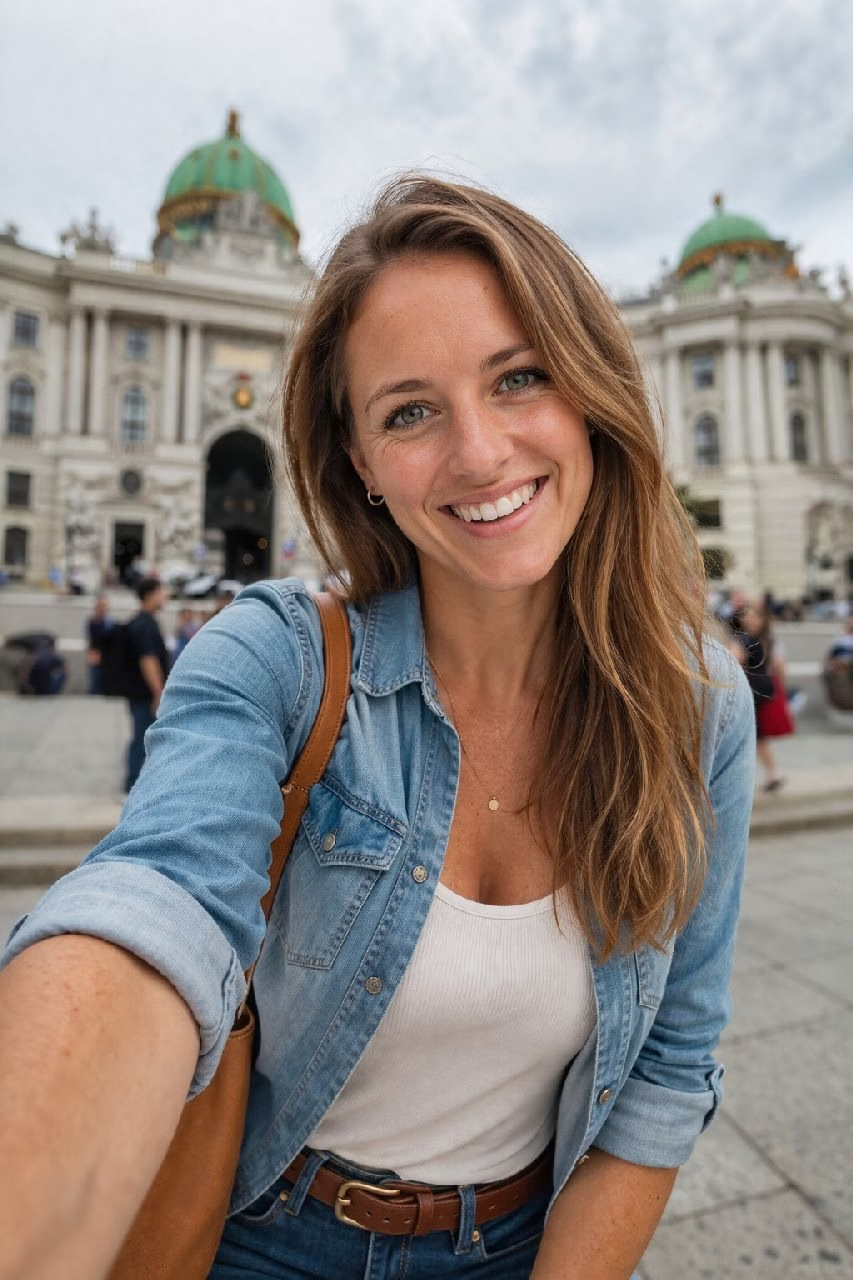
I’m Andrea, a travel writer based between Vienna and the Croatian coast, and I’ve been exploring both countries in depth for the past 10 years.
I’ve taken 50+ solo trips across Austria, Croatia, Germany, Switzerland, Slovenia, Italy and the wider Balkans, and I speak German, Croatian and English fluently, which means I get to have conversations most tourists never do. I know which Viennese coffee house the locals actually go to (hint: not the famous ones), and I know the Dalmatian islands well enough to tell you which ferry to take and which to avoid.
My writing is grounded in lived experience: I’ve navigated Austrian bureaucracy as a resident, hiked the Julian Alps in September when the crowds have gone, and eaten my way through Dubrovnik’s back streets at midnight. I cover Central Europe and the Adriatic for solo travellers who want something more than a highlight reel.
I also write in depth about Vienna and Austria at allaboutvienna.com, where you’ll find everything from neighbourhood guides to seasonal event coverage and expat tips.
When I’m not writing I’m usually hiking, swimming in the Adriatic, or arguing about which city makes better coffee. (It’s Vienna. It’s always Vienna.)