
 MAP
MAP SEARCH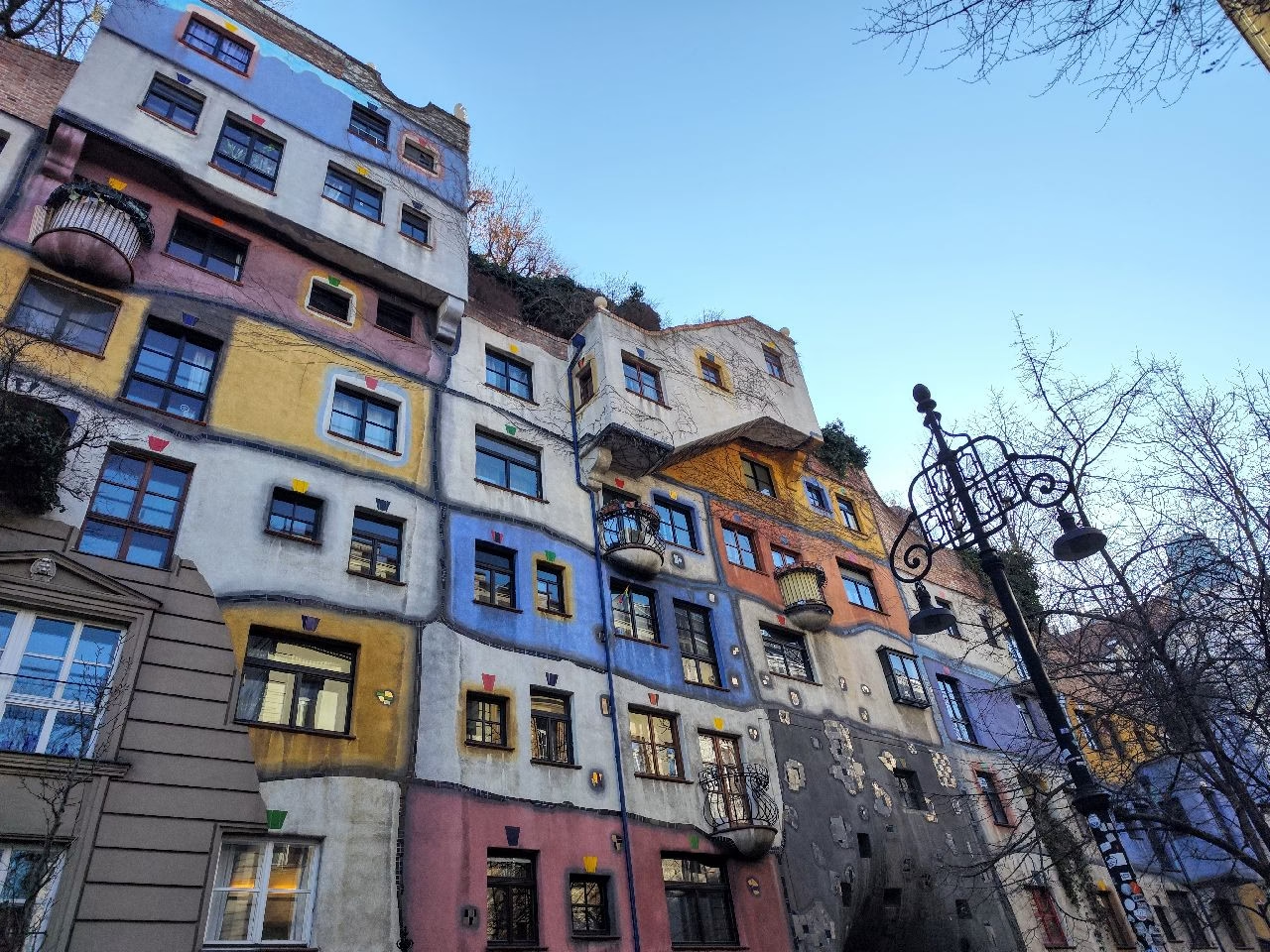
Hundertwasserhaus, Vienna
Address
Loewengasse 41-43, 1030 Vienna
GPS
48.2074029, 16.3937516
The Hundertwasserhaus is one of those buildings that stops people mid-stride. Located on the corner of Loewengasse and Kegelgasse in Vienna’s Third District, this residential apartment building completed in 1986 is so thoroughly unlike anything around it that first-time visitors sometimes wonder whether they are looking at a work of contemporary architecture or an unusually elaborate piece of street art. The answer is: both, and the distinction between the two impulses lies at the heart of everything Hundertwasser built.
Designed by the Austrian artist and architect Friedensreich Hundertwasser in collaboration with architect Josef Krawina, the building was commissioned by the City of Vienna as a deliberate experiment in humanised social housing. What resulted was one of the most distinctive pieces of residential architecture in the world: a building where no two windows are alike, where trees grow directly from inside the rooms and emerge through the facade, where the floors are intentionally uneven, and where the entire exterior is covered in a mosaic of colour and ceramic decoration that has no real parallel in the history of social housing anywhere in the world.
Before arriving, it is worth being clear about one important distinction. The Hundertwasserhaus on Loewengasse is a functioning residential apartment building; around fifty families live here, and the interior is not open to the public. Visitors come to photograph and appreciate the exterior, to walk the perimeter of the building, and to take in the adjacent Kalke Village shopping area designed in the same style. The Kunst Haus Wien, a dedicated Hundertwasser museum located a short walk away on Untere Weissgerberstrasse, is the publicly accessible exhibition space where you can go inside and learn about his work. Both are worth visiting; they serve different purposes.
Who Was Friedensreich Hundertwasser
Friedrich Stowasser was born in Vienna in 1928 and chose the name Friedensreich Hundertwasser as both an artistic statement and a philosophical declaration. Friedensreich translates as ‘realm of peace’; Hundertwasser means ‘hundred waters’. He was by any measure one of the most prolific and unconventional creative figures of the 20th century: a painter, printmaker, architect, and environmental activist whose work was unified by a deep hostility to the straight line.
Hundertwasser famously declared that the straight line is godless and immoral, a provocation he backed up with a lifetime of work in paint, mosaic, and architecture that sought to replace the rational geometry of modernist building with what he called the five skins of human existence: the epidermis, the clothing, the house, the social identity, and the global environment. His architecture, in his view, should accommodate the individual, grow organically, and maintain a living relationship with nature rather than imposing a uniform order upon it.
His major architectural works, beyond the Hundertwasserhaus, include the Waldspirale apartment building in Darmstadt, the KunstHausWien museum in Vienna, the Spittelau waste incineration plant (also in Vienna, which he redesigned with the same colourful philosophy), and a range of public buildings across Europe, New Zealand, and Japan. He died in 2000 aboard an ocean liner, and was buried on his property in New Zealand under a tulip tree, in accordance with his wishes for a natural burial.
The Building Itself: What to Look For
The exterior of the Hundertwasserhaus rewards careful observation rather than a single glance. The building covers an entire city block and its facade changes character as you walk around it, with each elevation offering a different arrangement of windows, balconies, columns, and ceramic detail.
The Windows
There are 250 windows on the Hundertwasserhaus and no two are identical. Each window has its own shape, size, and surround, and many are framed in contrasting colours or decorated with ceramic tile. Hundertwasser believed that the window was the most important element of any dwelling, because it represents the boundary between the private world of the resident and the public world outside. He granted each resident the right to paint the exterior wall around their own window in any colour or pattern they chose, creating what he called a ‘window right’ that made every occupant a co-author of the building’s appearance.
The Trees
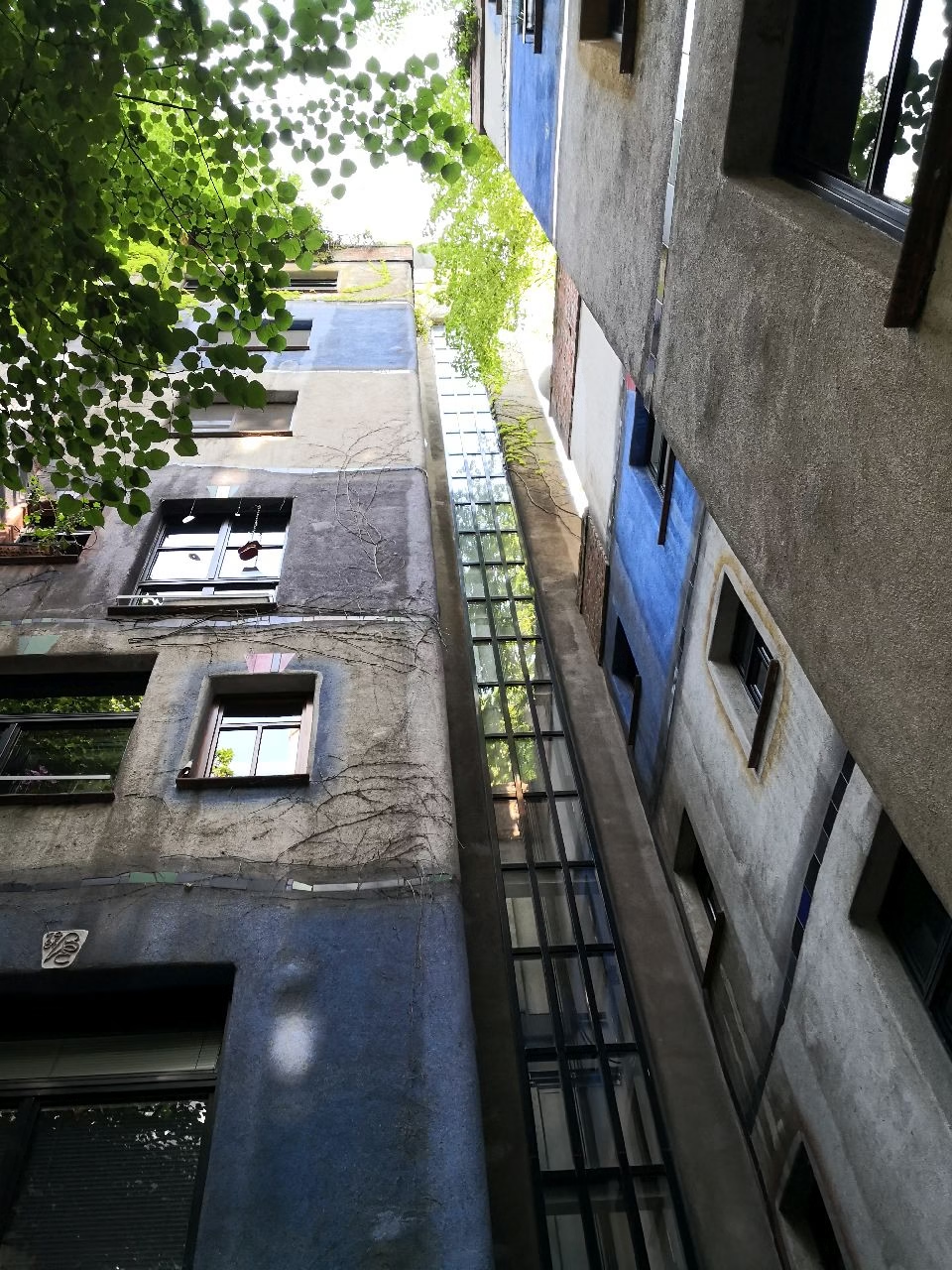
One of the most striking features of the building is the presence of living trees growing directly from within it. More than 250 trees and shrubs are planted throughout the structure, including on the roof terraces, on the balconies, and in several cases growing through openings in the floor slabs of individual apartments so that the trunk passes through the room and emerges above the roofline. Hundertwasser regarded this as a moral obligation: because the building occupied land that previously supported vegetation, it was the duty of the building to return that vegetation to the city in some form.
The Undulating Floors
The floors inside the building, though not visible to visitors from the street, are famously uneven. Hundertwasser believed that perfectly flat floors were a form of oppression, forcing the human body into an unnatural regularity of movement. The irregular surfaces of the Hundertwasserhaus floors were intended to engage the feet and mind simultaneously, to remind residents that they are walking on a living surface rather than a manufactured one. The original tenants were reportedly divided on this point.
The Facade
The exterior surface of the building is covered in a combination of render, ceramic tile, and mosaic work in shades of gold, red, blue, green, yellow, and terracotta. The colour palette changes across the different elevations and is particularly intense at the main corner, where the building turns from Loewengasse onto Kegelgasse. The onion-domed towers at the roofline and the gilded column capitals are among the most photographed details.
The Kalke Village Shopping Area
Immediately adjacent to the residential building, on the corner of Kegelgasse, is a small commercial complex built in the same architectural language as the Hundertwasserhaus. This is sometimes called the Hundertwasser Village or Kalke Village and it contains a small selection of souvenir shops, a cafe, and a gallery selling Hundertwasser prints and merchandise. This is the area where visitors can get closest to the building and where most photographs are taken. It is free to enter and explore.
The quality of the merchandise varies considerably, as it does in most tourist-adjacent shopping areas. The official Hundertwasser Foundation sells reproductions and licensed prints through its own channels; the street-level shops here are mostly independent vendors. If you are interested in genuine Hundertwasser prints, the shop at the Kunst Haus Wien museum down the road has a more carefully curated selection.
Kunst Haus Wien: The Museum Next Door
The Kunst Haus Wien, located at Untere Weissgerberstrasse 13 and a five-minute walk from the Hundertwasserhaus, is the publicly accessible counterpart to the residential building. It occupies a former factory building that Hundertwasser redesigned in 1989 with the same principles applied to the apartment building: irregular floors, colourful facades, trees growing from the structure, and an absolute rejection of straight lines wherever they could be avoided.
The museum contains a permanent exhibition of Hundertwasser’s paintings, prints, and architectural models spread across two floors, as well as a changing programme of temporary exhibitions by other artists. The permanent collection gives an excellent introduction to his work across five decades, from his early Viennese paintings of the 1950s through his mature graphic work and the large-scale tapestries of the 1970s and 1980s. The architectural section includes original models and drawings for the Hundertwasserhaus and other major buildings.
Admission to the Kunst Haus Wien is charged separately from any visit to the exterior of the Hundertwasserhaus, which is free. The museum is open daily and the combined visit to both locations can be comfortably accomplished in half a day.
How to Get There
The Hundertwasserhaus is located in the Third District, about 25 minutes on foot from Stephansplatz or easily reached by public transport. Tram line 1 stops at Hetzgasse, from which the building is a three-minute walk. Alternatively, tram line D stops at Schlachthausgasse. The U3 underground line stops at Rochusgasse, from which it is about a ten-minute walk.
The address of the building is Loewengasse 41-43, 1030 Vienna. The Kunst Haus Wien museum is at Untere Weissgerberstrasse 13, 1030 Vienna, and can be walked from the Hundertwasserhaus in around five minutes by following Kegelgasse and turning left.
When to Visit
The exterior of the Hundertwasserhaus is accessible at any time and there is no charge for viewing it from the street. The best light for photography is in the morning, when the sun hits the main Loewengasse facade directly. The building is heavily visited on weekends and during the summer tourist season; visiting on a weekday morning outside the July-August peak gives you considerably more space to photograph and observe without crowds.
The Kunst Haus Wien is busiest in the afternoon and on weekends. The museum also offers guided tours, which are worth booking in advance if you want a structured introduction to Hundertwasser’s thinking rather than a self-directed visit.
Tips for Your Visit
- The exterior is free to view at any time; allow 20 to 30 minutes to walk the full perimeter and photograph all four elevations.
- The Kalke Village shopping area adjacent to the building is open daily and has a cafe if you want to sit and observe the building at leisure.
- Combine the exterior visit with the Kunst Haus Wien museum for a full half-day itinerary in the Third District.
- From the Hundertwasserhaus, the Belvedere Palace is a 15-minute walk, making an easy combination for a full day in the Third District.
- Photography of the exterior is unrestricted. Photography inside the Kunst Haus Wien museum is permitted in the permanent collection but may be restricted in temporary exhibitions.
- The building is a working residential address: please be respectful of residents and do not attempt to enter the building or the private courtyard.
| Practical Info | Detail |
| Address | Loewengasse 41-43, 1030 Vienna (exterior, free to view at any time) |
| Kunst Haus Wien | Untere Weissgerberstrasse 13, 1030 Vienna |
| Kunst Haus Wien Hours | Daily 10:00 to 18:00 |
| Kunst Haus Wien Admission | Adults 12 euros; concessions available; free entry every first Sunday of the month |
| Getting there | Tram 1 to Hetzgasse; Tram D to Schlachthausgasse; U3 to Rochusgasse then 10 min walk |
| Nearest landmarks | Belvedere Palace (15 min walk); Museum of Military History (20 min walk); Stadtpark (20 min walk) |
| Best time to visit | Weekday mornings for photography; any time for the exterior |
| Time needed | 20-30 min for the exterior; 1.5-2 hours for Kunst Haus Wien; half a day for both |
| Explore the Third District The Hundertwasserhaus sits in a part of Vienna that rewards a full afternoon of exploration. See our Third District (Landstrasse) neighbourhood guide for the Belvedere, the Hundertwasserhaus, and the Museum of Military History in one itinerary. |