
 MAP
MAP SEARCH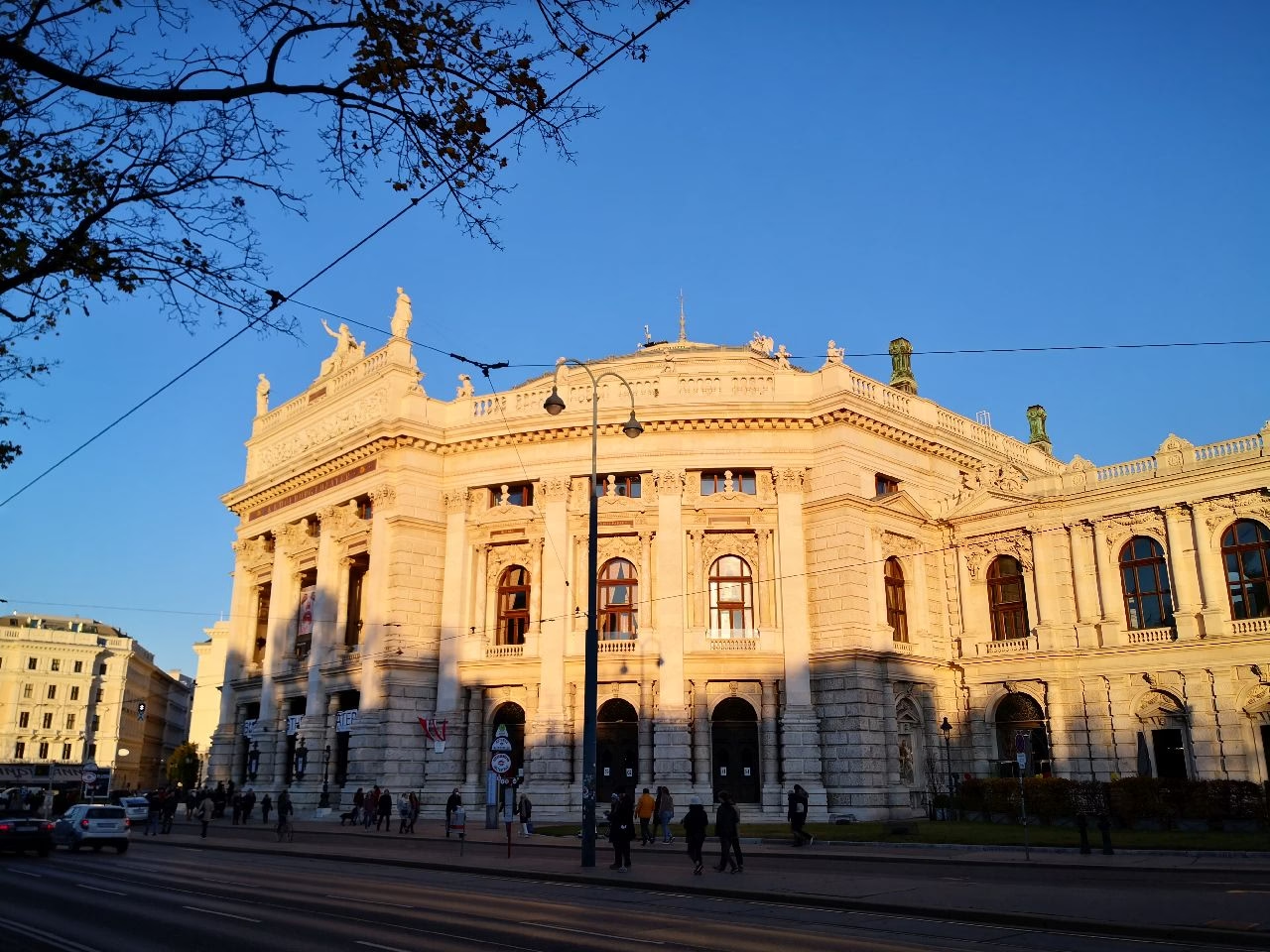
Burgtheater Vienna
Address
Universitaetsring 2, 1010 Vienna
GPS
48.210337, 16.3614778
The Burgtheater stands on the Ringstrasse directly opposite the Rathaus, and anyone who has walked past it at night when the lights are on and the audience is gathering for a performance will understand immediately why it occupies the position it does in Viennese cultural life. It is not merely a theatre; it is an institution that has been at the centre of German-language culture for more than two and a half centuries, and the weight of that history is present in every element of the building, from the grand frescoed staircase to the auditorium where the most important actors and directors of the past hundred years have worked.
For visitors to Vienna who have any interest in theatre, architecture, or cultural history, the Burgtheater deserves a place on the itinerary alongside the State Opera and the Musikverein. It can be appreciated at several levels: the building itself is extraordinary, guided tours run regularly and are among the most informative in the city, and attending a performance is a genuine cultural event even for visitors who do not speak German.
History of the Burgtheater
The Burgtheater traces its origins to 1741, when Empress Maria Theresa established a court theatre in the Ballhaus adjacent to the Hofburg Palace. The Burgtheater, or ‘Court Theatre’, was granted its official charter by Emperor Joseph II in 1776, the same year he designated it the National Theatre of the German lands: a declaration of cultural ambition that shaped its programming and self-understanding for the following two centuries.
The original Ballhaus theatre served the company until 1888, when the new Ringstrasse building designed by architects Gottfried Semper and Karl von Hasenauer was completed and opened. The transition to the new building was not without controversy: the original design was criticised for poor sightlines in parts of the auditorium, and modifications were made several times in the first years of operation. The building was severely damaged in the final days of the Second World War in 1945, when fire destroyed the stage, the auditorium, and much of the backstage area. The exterior and the grand ceremonial staircases survived. The theatre was rebuilt and reopened in 1955, the same year as the Vienna State Opera’s much more celebrated postwar reopening.
During its history, the Burgtheater has been associated with some of the most significant figures in European theatre. Arthur Schnitzler, Hugo von Hofmannsthal, Thomas Bernhard, and Peter Handke are among the Austrian dramatists whose major works premiered here. Directors including Max Reinhardt, Claus Peymann, and Matthias Hartmann have shaped the artistic identity of the institution at different periods. The ensemble model, in which a permanent company of actors works across the repertoire rather than being engaged production by production, remains central to the Burgtheater’s identity and gives its performances a quality of collective artistic investment that is less common in commercial theatre.
The Architecture
The Ringstrasse building is one of the finest examples of late historicist architecture in Vienna, designed in the Italian Renaissance style by Semper and Hasenauer and completed as part of Emperor Franz Joseph’s grand urban transformation of the city centre. The exterior is dominated by the two symmetrical wings that flank the central portico, and by the two loggia-level balconies from which, famously, the audience at the first performance in 1888 could see the stage only with difficulty.
The Grand Staircase and Foyers
The ceremonial staircases in the two wings of the building are the architectural highlight of any visit to the Burgtheater, and they survived the 1945 fire intact. The ceiling frescoes on the staircases were painted by a group that included a young Gustav Klimt and his brother Ernst, along with their collaborator Franz Matsch. These early Klimt works, completed between 1886 and 1888 when Gustav was in his mid-twenties, predate the radical style shift that would produce the Secession and the celebrated golden paintings; they are academic and accomplished rather than revolutionary, and fascinating as a record of where the artist began.
The foyers of the Burgtheater are decorated with portraits of the theatre’s most celebrated actors from the past two centuries. Walking through them before a performance or on a guided tour is a compressed history of German-language acting, with faces and names that remain significant in the culture: Josef Kainz, Hedwig Bleibtreu, Paula Wessely, and many others.
The Auditorium
The main auditorium seats just over 1,000 people across the stalls, three tiers of boxes, and a gallery. The design, in its post-war reconstruction, addressed the original sightline problems with modest success; the lateral boxes at the extreme ends of each tier still offer compromised views of the full stage, but the acoustics and general atmosphere of the room are excellent. The house is intimate enough for the audience to feel genuinely close to the performance even from the upper gallery.
The Burgtheater also operates two smaller stages: the Akademietheater, a 500-seat venue in the Third District used for smaller-scale productions and experimental work, and the Vestibul, a minimal performance space within the main building used for readings, concerts, and occasional small productions.
Guided Tours
The Burgtheater offers guided tours of the building in German and English, typically running for about an hour and covering the grand staircase, the foyers, the Klimt ceiling frescoes, the auditorium, and parts of the backstage area including the stage itself. Tours run most days and include access to areas not visible from the public foyers, including the dressing rooms and the fly tower above the stage.
The tours are highly recommended for anyone with an interest in theatre or in the Klimt frescoes, which are not well known internationally but are significant works in the context of the artist’s development. Booking in advance is advisable, particularly in the summer when tour groups fill the available places quickly.
Attending a Performance
Attending a performance at the Burgtheater is a more accessible proposition than many visitors assume. The theatre performs in German, and the vast majority of productions have no surtitles in other languages; this means that visitors without German language skills will follow the performances with varying degrees of ease depending on how familiar they are with the play being performed. Classical works by Shakespeare, Chekhov, Moliere, and other canonical playwrights are more accessible to non-German speakers who know the text than new Austrian plays, which require a good level of the language to follow.
That said, the Burgtheater is worth attending even with limited German, particularly for productions with strong visual or physical theatre elements, or for contemporary works where the staging carries as much meaning as the text. The experience of being in the auditorium, of the house lights going down and the curtain rising in one of the oldest and most important theatres in the world, is genuinely valuable regardless of linguistic access.
Buying Tickets
Tickets for the Burgtheater are sold through the Bundestheater ticketing system, which covers the Burgtheater, the Vienna State Opera, the Volksoper, and the Akademietheater. Prices range from around 3 euros for standing places (Stehplatz) to 50 euros or more for premium stalls seats, with most tickets in the 15 to 35 euro range. The Stehplatz tickets, available from 30 minutes before the performance at the box office, are excellent value and place you in a standing area at the rear of the stalls with a clear view of the stage.
The season runs from September through June. The summer months (July and August) see the main stages go dark, though open-air performances and special events sometimes fill part of the gap. The programme is published on the Burgtheater’s official website and tickets can be booked online from the start of the season.
Dress Code and Etiquette
The Burgtheater has no strict dress code, but Viennese audiences tend to dress well for evening performances, particularly for premieres and high-profile productions. Smart casual is perfectly acceptable. Evening performances typically begin at 19:30 and run for two to three hours including one or two intervals. The box office opens one hour before curtain.
What Else Is Nearby
The Burgtheater sits on the inner Ringstrasse directly opposite the Rathaus (City Hall) and a short walk from the Volksgarten, the Parliament building, and the University of Vienna. The Rathaus park in front of the City Hall hosts the summer Filmfestival Wien (free outdoor cinema in July and August) and the Christmas market in November and December. The walk from the Burgtheater to the Kunsthistorisches Museum takes about ten minutes along the Ring.
| Practical Info | Detail |
| Address | Universitaetsring 2, 1010 Vienna |
| Guided Tours | Daily; English and German; approx. 1 hour; book in advance at burgtheater.at |
| Tour Price | Adults 10 euros; students 7 euros |
| Performance Tickets | 3 euros (standing) to 50+ euros (stalls); book at bundestheater.at |
| Season | September to June; some summer events |
| Box Office | Opens 1 hour before each performance |
| Getting there | U2 to Rathaus; Tram 1, D, 71 along the Ringstrasse |
| Nearest landmarks | Rathaus (opposite); Volksgarten (adjacent); Kunsthistorisches Museum (10 min walk) |
| Plan your Ringstrasse walk The Burgtheater is one of the anchors of the Ringstrasse boulevard. See our Ringstrasse guide for a full walking itinerary covering all the major buildings, from the Staatsoper to the Parliament. |